
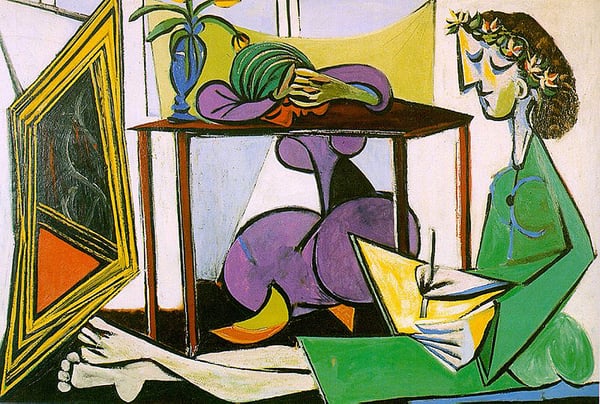
Pablo Picasso sanatçısının Interior with girl drawing eseri hakkında uzman analizi
Tarz: Cubism, Surrealism · Tür: genre painting
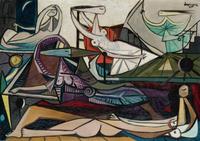
Analysis of "Interior with girl drawing" by Pablo Picasso
Artist & Context: Pablo Picasso (1881–1973)
Style(s): Cubism, Surrealism
Genre: Genre painting (domestic interior scene)
Period: Later Years (post‑WWII, roughly 1946–1973)
Significance within Picasso’s Oeuvre
During his later years, Picasso frequently revisited and synthesized the revolutionary languages he had pioneered earlier in the century. Interior with girl drawing exemplifies this mature synthesis: it merges the fragmented, multi‑perspectival space of Cubism with the dreamlike, psychologically charged distortions of Surrealism. The result is a work that feels both spatially radical and emotionally intimate.
What makes the work significant
-
Blending of Two Avant‑Garde Movements
- The composition employs Cubist faceting—the girl’s body, the furniture, and the room’s angles are presented from multiple viewpoints simultaneously.
- Yet the arrangement also carries a Surrealist strangeness: proportions are deliberately skewed (e.g., oversized hands, elongated neck), and the interior seems to warp around the figure, as if seen in a dream or memory.
- This hybrid approach demonstrates Picasso’s refusal to be confined to a single ism, and it reflects his lifelong belief that art should constantly reinvent itself.
-
Elevation of a Mundane, Genre‑Painting Subject
- Genre paintings traditionally depict everyday life, often domestic scenes. By choosing a girl drawing in an interior, Picasso turns the act of creation itself into the subject.
- The “girl drawing” is likely one of his children or a young friend—Picasso was fascinated by childhood creativity and often portrayed his own offspring (e.g., Paloma, Claude). The work thus becomes a meta‑commentary on the artist’s own process: drawing as a primal, generative act.
- The Cubist/Surrealist handling transforms a quiet domestic moment into a monumental statement about perception, time, and the artist’s hand.
-
Characteristics of Picasso’s Late Style
- In his later period, Picasso’s linework became increasingly free, almost calligraphic, while his palette grew brighter and more arbitrary. Interior with girl drawing likely exhibits bold outlines, flattened planes of color, and a playful disregard for naturalistic shading.
- The work also shows his late‑life preoccupation with the relationship between the artist and the model—here, the model is also a maker, blurring the boundary between observer and creator.
- By embedding a Cubist grid within a Surrealist atmosphere, Picasso proves that the formal innovations of the 1910s remained alive and capable of generating fresh emotional resonance decades later.
Conclusion
Interior with girl drawing is significant because it encapsulates Picasso’s enduring ability to merge stylistic opposites (Cubist structure with Surrealist flux) while reinvesting a humble genre scene with profound artistic and autobiographical meaning. It stands as a testament to his ceaseless experimentation in the final decades of his career, proving that even a simple interior could become a laboratory of modern vision.
Görsel olarak benzer
İlişkili kompozisyon ve renk paletine sahip 20 eser
Portrait of woman
Pablo Picasso
Woman reading
Pablo Picasso
Skull and leeks
Pablo Picasso
A muse
Pablo Picasso
Two figures
Pablo Picasso
Portrait of woman
Pablo Picasso
Still life with skull on an armchair
Pablo Picasso
Scheiber Hugó, Barátnők
Scheiber Hugó
Painter and his model
Pablo Picasso
Untitled
Pablo Picasso
Woman by the dresser
Pablo Picasso
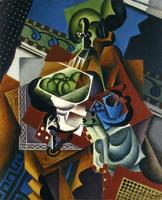
Still Life: Playing Cards, Coffee Cup and Apples
Jean Metzinger
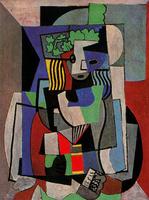
The student
Pablo Picasso
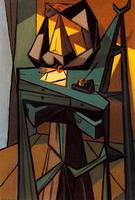
Femme à l'Ecritoire
Oscar Dominguez
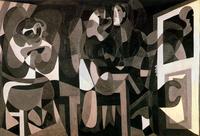
Milliners (Workshop of the milliner)
Pablo Picasso
Breakfast
Pablo Picasso
Scheiber Hugó, Bárban, ,.
Scheiber Hugó
Zátiší Na Stole
Emil Filla
Untitled
Pablo Picasso
Les Odalisques
Oscar Dominguez