
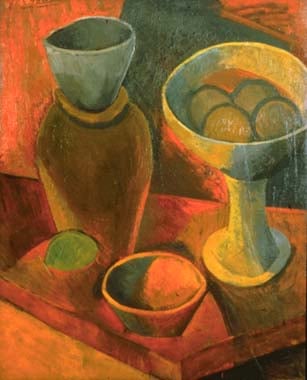
Expertenanalyse zu Pablo Picassos Jug and fruit dish
Stil: Analytical Cubism · Genre: still life
Expert Analysis: "Jug and fruit dish" by Pablo Picasso
Although Pablo Picasso’s "Jug and fruit dish" is classified under Analytical Cubism and falls chronologically within his African Period, this intersection of styles is precisely what makes the work significant. The painting represents a crucial transitional moment: the raw, sculptural energy of African art is being channeled into the intellectual, multi-perspectival language that would define high Cubism.
Significance within Analytical Cubism
The painting treats the still-life subject—a jug and a fruit dish—as a problem of perception rather than representation. Picasso reduces the objects to faceted, interlocking planes, tilting the tabletop upward so that the viewer sees the dish simultaneously from above and from the side. The monochromatic palette (ocher, brown, gray) typical of Analytical Cubism forces attention to structure rather than color. The jug’s neck is fractured and splayed, while the fruit dish is decomposed into a series of transparent, overlapping arcs. This is not a window onto reality but a constructed argument about how we see: from multiple angles in a single frozen moment.
Legacy of the African Period
The so-called African Period (1907–1909) initially manifested through mask-like faces and heavy contours in figural works. Here, that influence is embedded in the still life’s geometry. The jug’s handle and rim echo the angular, carved volume of African sculpture—the forms feel hewn rather than painted. The dark outlines and abrupt shifts in plane create an effect of frontality and flatness that owes more to tribal masks than to European illusionism. By applying these principles to a humble tabletop arrangement, Picasso democratizes the African aesthetic: it is no longer limited to exotic figures but informs the very fabric of ordinary objects.
Synthesis and Breakthrough
What makes "Jug and fruit dish" truly significant is how it marries the primitive power of the African Period with the analytic rigor of Cubism. The painting is neither purely decorative nor purely intellectual; it is a tactile dissection of form where every facet carries the weight of both a conceptual system and a visceral, earthbound influence. This synthesis anticipates the later synthetic Cubism, where Picasso would collage real-world materials into the picture plane. Here, the African-derived angularity keeps the cerebral Cubist analysis grounded in material, almost ceremonial presence—a jug and a dish transformed into totems of modern vision.
Visuell ähnlich
20 Werke mit ähnlicher Komposition und Farbpalette
Still Life
Constantin Blendea
Still Life with Knife
Maurice de Vlaminck
Czóbel Béla , Still Life,. .
Bela Czobel
Portugese Still Life
Sonia Delaunay
Dessert
Auguste Herbin
Still Life
Constantin Blendea
Guitar, Fruit and Pitcher
Georges Braque
Czóbel Béla Csendélet Vegyes Technika,70x59cm
Bela Czobel
Still life on the dresser
Pablo Picasso
Still life
Niko Pirosmani
Nature Morte au Chinois
André Lhote
Modok Mária, Csendélet Korsóval Almákkal
Modok Mária
Vase with flowers
Pablo Picasso
Still life with fruits
Elena Bontea
Still Life with Two Tables
Max Weber
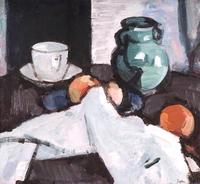
Still Life with Bowl of Fruit, Jug, Cup and Saucer
Samuel Peploe
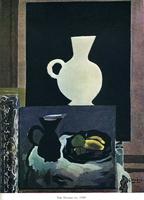
The Studio (I)
Georges Braque
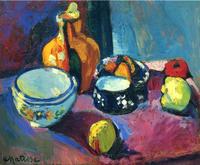
Dishes and Fruit on a Red and Black Carpet
Henri Matisse
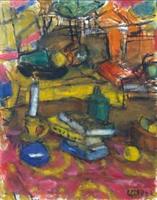
Czobel Bela Csendélet Gyergyával
Bela Czobel
Bela Adalbert Czobel Still Life Wit Flowers and
Bela Czobel