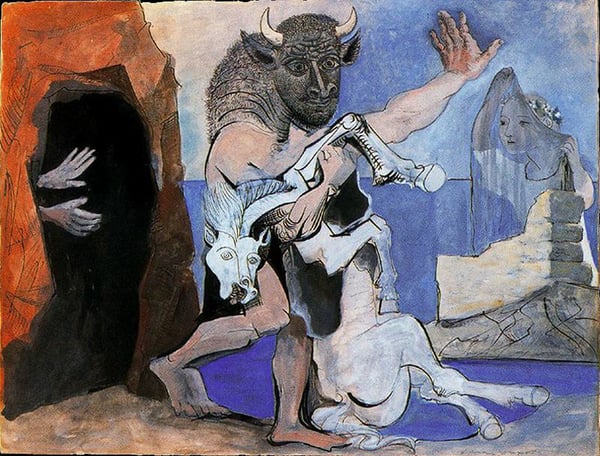
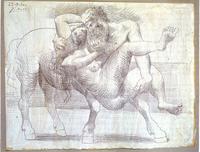
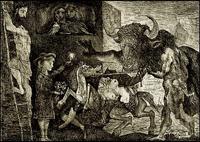
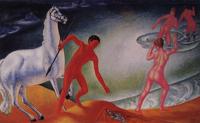
Expert Analysis: "Minotaur with dead horse in front of a cave facing a girl in veil" by Pablo Picasso
This work occupies a pivotal moment in Picasso’s career, bridging his Neoclassicist precision with the raw psychological energy of Surrealism. Painted during his Neoclassicist & Surrealist Period, the piece channels classical mythology through an Expressionist lens—the violent, distorted forms betraying an inner turmoil that Surrealism sought to unlock.
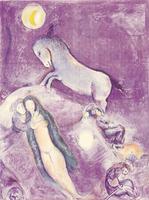
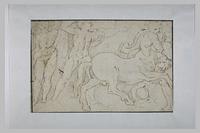
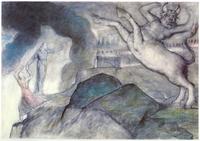
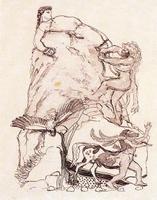
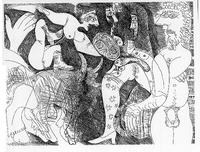
The Minotaur, a recurring surrogate for Picasso himself, stands before a dead horse (a symbol of brute force spent) and a cave—the archetypal womb of the unconscious. The veiled girl introduces an air of mystery, evoking both classical maiden and Surrealist enigma. Here, myth becomes a vehicle for exploring primal instincts, mortality, and desire. The formal tension between Picasso’s crisp Neoclassic silhouettes and the Expressionistic distortion of figures marks a unique synthesis: the rationality of antiquity is shattered by the irrationality of the modern psyche.
Significantly, this image prefigures the dark, tormented imagery of Guernica (1937), where the Minotaur’s brutality and the horse’s agony would merge into a universal cry against war. In its fusion of mythological narrative, Expressionist emotion, and Surrealist dream-logic, the work stands as a landmark of Picasso’s ability to reinvent tradition for the modern age—making the ancient Minotaur a haunting mirror of 20th-century consciousness.