
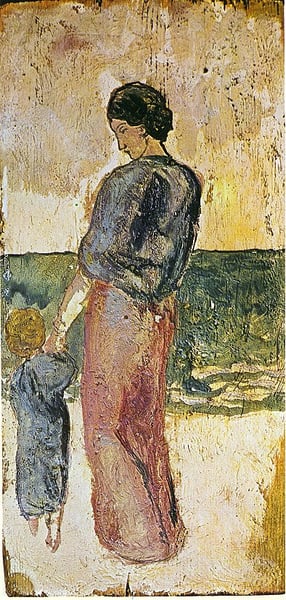
Mother and child on the beach
Dettagli
Analisi esperta di Mother and child on the beach di Pablo Picasso
Stile: Post-Impressionism · Genere: genre painting
Expert Analysis: "Mother and Child on the Beach" (1902) by Pablo Picasso
Significance within the Blue Period:
Painted during Picasso’s deeply introspective Blue Period (1901–1904), Mother and Child on the Beach exemplifies the artist’s shift from youthful exuberance to a somber, socially engaged realism. The work is a quintessential genre scene—an everyday moment of maternal care—transformed by the period’s signature monochromatic palette of cool blues, blue-greens, and muted grays. This chromatic restraint is not merely aesthetic; it conveys the emotional isolation, poverty, and melancholy that define the Blue Period’s response to human suffering.
Stylistic and Formal Innovations:
Picasso, working within the broader Post-Impressionist tradition, abandons naturalistic color and perspective in favor of flattened, almost sculptural forms. The mother’s elongated limbs and bowed head echo El Greco’s spiritual intensity, while the simplified, blocky contours anticipate Picasso’s later move toward Cubism. The beach setting—usually a site of leisure—is drained of warmth; the figures appear stranded in a cold, shallow space, their gazes averted or downcast. This tension between a mundane subject and its emotional weight makes the painting a landmark of the Blue Period’s fusion of Symbolist mood with Modernist form.
Thematic Resonance:
Unlike idealized depictions of maternity, Picasso’s mother and child feel vulnerable, almost ghostly. The child clings to the mother, but she offers no comfort—her distant stare suggests fatigue or loss. Art historians often read this work as an allegory of poverty, reflecting the artist’s own financial struggles and his empathy for the marginalized in Barcelona’s slums. The painting thus bridges the 19th-century tradition of sentimental genre painting and the 20th-century drive to express psychological truth through formal innovation.
Why It Matters:
Mother and Child on the Beach is a pivotal example of how Picasso used the Blue Period to strip art of ornament and sentiment, substituting a raw, poetic austerity. Its significance lies in its power to evoke universal emotions—loneliness, protection, despair—through deceptively simple means, laying the groundwork for the revolutionary breakthroughs of his Rose Period and Cubism.
Visivamente simili
20 opere con composizione e palette affini
Woman with Loose Red Hair
Edgar Degas
Woman on the Seashore
Gheorghe Petrascu
Woman in the Wind by the Sea
Franz Marc
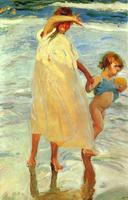
The two sisters
Joaquín Sorolla
A Virgin (study)
Abbott Handerson Thayer
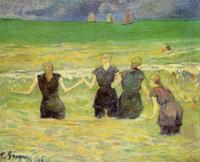
Women bathing (Dieppe)
Paul Gauguin
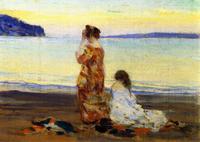
Beach Scene, Baie-Saint-Paul
Clarence Gagnon
Women at the sea
Jan Toorop
On the Seashore
Nicolae Vermont
Girl on the Seashore
Gheorghe Petrascu
Man and Woman on the Beach
Thomas Pollock Anshutz

Three Friends
Adolphe Joseph Thomas Monticelli
At the Beach
Edward Henry Potthast
The Girl on the Cliff
Augustus John

Spring
Mikhail Larionov
Berény Róbert, Duna Parton
Berény Róbert
Girl with Red Stockings
Pierre-Auguste Renoir
Women and Little Girls in a Natural Setting
Berthe Morisot
Children in the Sea
Joaquín Sorolla
At the Seashore
Edward Henry Potthast