
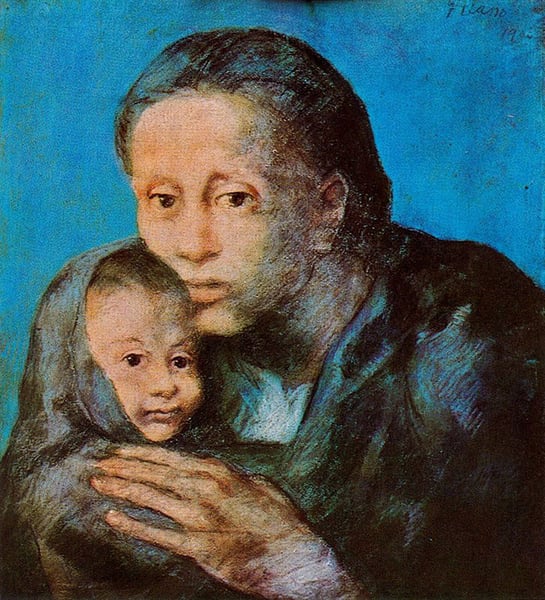
Analisi esperta di Mother and son with handkerchief di Pablo Picasso
Stile: Expressionism · Genere: genre painting
Expert Analysis: “Mother and Son with Handkerchief” by Pablo Picasso
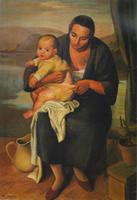
Pablo Picasso’s Mother and Son with Handkerchief stands as a poignant touchstone of his Blue Period (1901–1904), a phase defined by melancholic monochrome palettes, elongated figures, and themes of poverty, isolation, and human suffering. Executed in shades of blue and blue‑green, the work exemplifies how Picasso transformed personal despair—triggered by the suicide of his friend Carlos Casagemas—into a universal language of empathy.
Expressive Distortion and Composition
As an Expressionist genre painting, the artwork prioritizes emotional truth over naturalistic representation. The mother’s angular, almost skeletal face and the child’s oversized head reflect the stylized elongation typical of the Blue Period, echoing the influence of El Greco and symbolist art. The titular handkerchief—likely a signifier of tears or illness—anchors the narrative: a humble gesture of care amidst destitution. The figures are pressed into a shallow, claustrophobic space, their gazes averted or downcast, intensifying the atmosphere of quiet grief.
Significance Within the Blue Period
This painting is significant because it distills the core concerns of Picasso’s Blue Period: vulnerability, maternal sacrifice, and social marginality. Unlike later works that overtly critique social ills (e.g., The Old Guitarist), here the tragedy is intimate, domestic. The mother’s protective embrace is both tender and desperate; the child’s inert pose suggests illness or exhaustion. The use of a single, limited palette forces the viewer to focus on form and emotional weight—a technique that would later influence Picasso’s transition into Cubism.
Moreover, the handkerchief serves as a subtle symbol of class and struggle: a small, everyday object that becomes a relic of hardship. By elevating such a humble scene into high art, Picasso aligns himself with the tradition of genre painting (scenes of daily life) while subverting it with modernist melancholy. The work thus bridges his academic training and his emerging avant‑garde voice, marking a critical step toward the psychological depth that would define his career.
Visivamente simili
20 opere con composizione e palette affini
Woman and Child
Pierre-Auguste Renoir
Mother and Child
Louay Kayyali
The Artist's Wife and Baby
David Bomberg
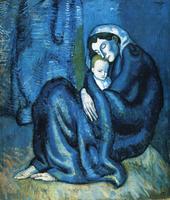
Mother and child
Pablo Picasso
An Irish Idyll
Sarah Purser
Mother and daughter
Odd Nerdrum
Mrs George Caleb Bingham (Sarah Elizabeth Hutchison) and Son, Newton
George Caleb Bingham
Grandchild
Alekos Kontopoulos
Mother and Child
Victor Palmov
Mother and Child Reading
Mary Cassatt
Mrs. Joseph Martin and her Son Charles
Joshua Reynolds
Peasant Woman with a Child in Her Lap
Vincent van Gogh
Sketch of Mother Looking down at Thomas
Mary Cassatt
Madonna and Child
Titian
Modok Mária, Anyaság
Modok Mária
Pietà
Magnus Enckell
Helene de Septeuil
Mary Cassatt
Woman with child
Pablo Picasso
Conversation Piece: Three Heads
Theodule Ribot
Madonna col Bambino
Mario Tozzi