
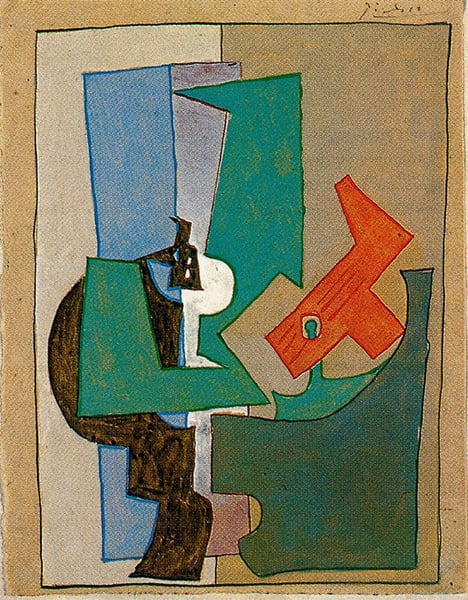
Pedestal
Подробности
Экспертный разбор работы «Pedestal» художника Pablo Picasso
Стиль: Cubism · Жанр: still life
Expert Analysis: "Pedestal" by Pablo Picasso
Style: Cubism | Genre: Still Life | Period: Neoclassicist & Surrealist Period
Significance within style and period
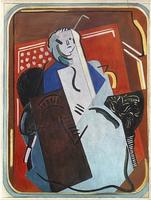
"Pedestal" occupies a fascinating crossroads in Picasso’s career. Stylistically rooted in Cubism—the revolutionary movement he co-founded that fractures objects into geometric facets and presents multiple viewpoints simultaneously—the work is, paradoxically, dated to his Neoclassicist & Surrealist Period. This temporal overlap gives the painting its distinctive significance: it is a Cubist still life created during a phase when Picasso was simultaneously exploring classical order and dreamlike metamorphosis.
What makes the work significant
-
Bridging two modes – The pedestal, a traditional subject of classical still life, is treated with Cubist fragmentation. Yet the choice of a pedestal (a static, architectural form) hints at the monumentality and stability Picasso pursued in his neoclassical works. The result is a dialogue between the analytical breaking of form and a yearning for structural permanence.
-
Proto-Surrealist tension – In the Surrealist vein, the ordinary still-life motif becomes uncanny. The pedestal, usually a support for other objects, is itself the subject. Deconstructed and rearranged, it floats in an ambiguous space—suggesting not a stable tabletop but a dreamlike plane where logic is suspended. This prefigures Surrealism’s interest in the irrational and the altered reality of objects.
-
Period synthesis – Few works so explicitly demonstrate Picasso’s ability to fuse his own revolutionary Cubist language with the broader stylistic currents of his time. "Pedestal" is not merely a Cubist relic but a living document of how Picasso could revisit Cubist methods even as his practice evolved toward neoclassical figuration and surrealist imagination.
Conclusion
"Pedestal" is significant as a hybrid artwork—one that applies Cubist deconstruction to a still-life that simultaneously evokes the architectural solidity of neoclassicism and the psychological displacement of surrealism. It reveals Picasso’s refusal to be confined by chronology, instead weaving a span of his own stylistic innovations into a single, complex still life.
Визуально похожие
20 работ с близкой композицией и палитрой
Bodegón Cubista
Maria Blanchard
Woman sitting in an armchair
Pablo Picasso
Composition, cubisme ornemental
Serge Charchoune
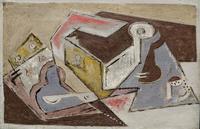
Naturaleza Muerta Con Tijeras
Maria Blanchard
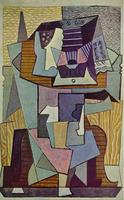
The table
Pablo Picasso
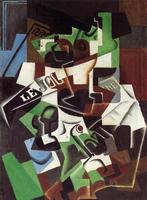
Fruit Bowl, Pipe and Newspaper
Juan Gris
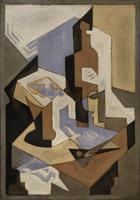
Composición Cubista Con Botella
Maria Blanchard
Nuit II (Composition with Frog)
Louis Marcoussis
Untitled
Pablo Picasso
Man with mandolin
Pablo Picasso
Bottle of Beaune and a Fruit Dish
Juan Gris
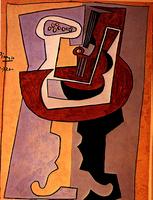
Man with mandolin
Pablo Picasso
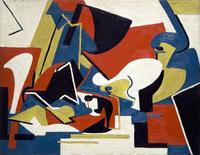
Untitled
Lee Krasner
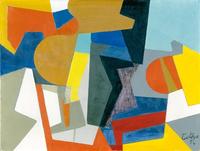
Les Goudes
Maurice Esteve
Les Goudes
Maurice Esteve
Newspaper, Glass and Pear
Juan Gris
Guitar on pedestal
Pablo Picasso
Composición Cubista
Maria Blanchard
La bouteille
Henri Laurens
Femme au Fauteuil
Albert Gleizes