
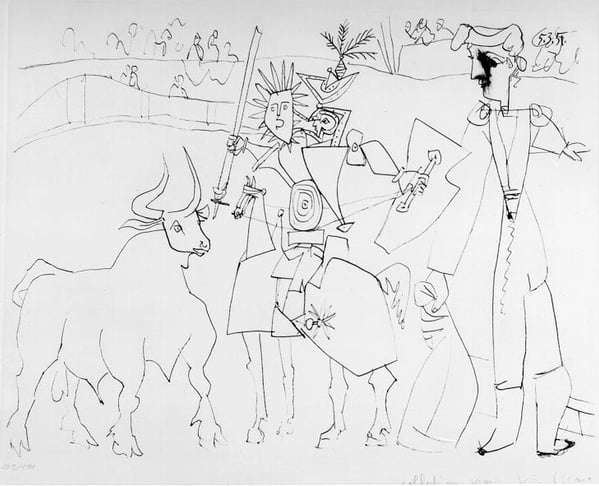
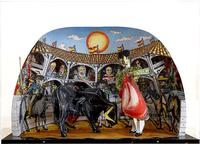
Picador on the horseback on arena
Dettagli
Analisi esperta di Picador on the horseback on arena di Pablo Picasso
Stile: Surrealism · Genere: genre painting
Expert Art Historical Analysis: "Picador on the horseback on arena" by Pablo Picasso
Context and Stylistic Significance
Painted during Picasso’s Later Years, this work situates itself within the broader Surrealist movement while reflecting the artist’s mature, idiosyncratic approach. Surrealism, which sought to liberate the unconscious mind through dreamlike, irrational juxtapositions, is here channeled through a subject deeply personal to Picasso: the bullfight. The picador—a mounted bullfighter who pierces the bull with a lance—becomes a vehicle for exploring the tension between reality and the subconscious. In Picasso’s later period, he frequently returned to the corrida as a metaphor for life, death, and artistic struggle, but filtered through a Surrealist lens that distorts form, scale, and perspective.
Genre and Narrative
As a genre painting, this work depicts a scene from everyday (or ritualistic) life—the Spanish bullfight—but transforms it into a psychological theater. The arena, typically a space of physical action, becomes a stage for surreal disquiet. The picador on horseback is not rendered with naturalistic precision; instead, Picasso likely fragments the figures, elongates limbs, or flattens spatial depth, aligning with Surrealism’s rejection of conventional representation. The horse and rider may appear disjointed or suspended in an ambiguous void, emphasizing the dreamlike quality of the moment.
What Makes It Significant
-
Synthesis of Personal Iconography and Surrealist Language: Picasso’s lifelong fascination with bullfighting—rooted in Spanish culture and his own biography—merges with Surrealism’s subversive logic. The picador, a symbol of aggression and vulnerability, allows Picasso to explore violence and ritual through a distorted, unconscious prism. This synthesis is rare in Surrealism, which often avoided such culturally specific, narrative themes.
-
Late Period Reinvention: In his later years, Picasso broke from earlier Cubist and Surrealist orthodoxy, infusing his works with raw emotional energy and experimentation. Here, the Surrealist label is less about strict adherence to André Breton’s manifestos and more about a liberated approach to form and meaning. The painting’s significance lies in how it demonstrates Picasso’s personal Surrealism—one where the arena becomes a psychic space, and the picador a cipher for the artist’s confrontation with mortality.
-
Genre Painting as Surrealist Statement: By choosing a genre scene, Picasso elevates the quotidian into the extraordinary. The bullfight, a real event, is rendered with irrational distortions (e.g., disproportionate horse, floating picador), challenging the viewer’s expectations of reality. This tension between the mundane and the bizarre is a hallmark of Surrealist genre painting, positioning the work as a key example of how later Surrealism could remain provocative without abandoning narrative.
Conclusion
“Picador on the horseback on arena” is significant as a late-career fusion of Picasso’s autobiographical motifs with Surrealist techniques of estrangement. It reimagines a traditional genre through the lens of the unconscious, proving that even in his later years, Picasso could reinvigorate his practice by blending the familiar (the Spanish bullfight) with the unsettling logic of Surrealism.
Visivamente simili
20 opere con composizione e palette affini
Corrida II
Oscar Dominguez
TJURFÄKTNINGSSCEN
Gosta Adrian-Nilsson
Bull and Matador III
Gosta Adrian-Nilsson
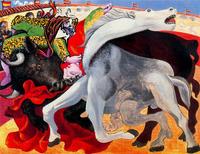
Bullfight, the death of the torero
Pablo Picasso
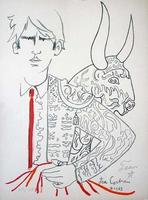
Toréador
Jean Cocteau
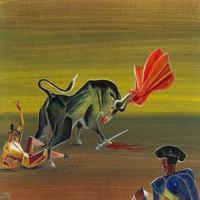
Scene from a Bullfighting Area
Gosta Adrian-Nilsson
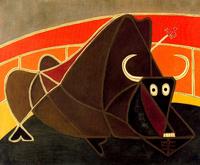
Tauromaquia
Oscar Dominguez
Bullfighting
HRASARKOS
The Bravery of Martincho in the Ring of Saragassa
Francisco Goya
Tauromaquia
Oscar Dominguez
Toreo Noir
Salvador Dali
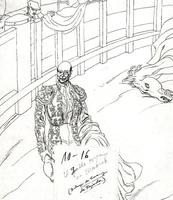
The Chapman
Carlos Saenz de Tejada
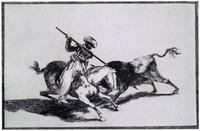
The Morisco Gazul is the First to Fight Bulls with a Lance
Francisco Goya
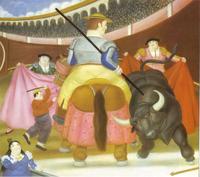
The Pica
Fernando Botero
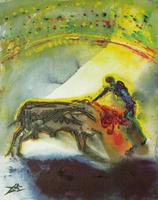
Tauromachia I - The Torero, the Kill (third and final round of the bullfight)
Salvador Dali
The Famous American, Mariano Ceballos
Francisco Goya
Sebastia Junyer-Vidal as matador
Pablo Picasso
Seville. The bullfight.
Vasily Surikov
Bull/Matador
Elaine de Kooning
Los Aficianados
Red Grooms