
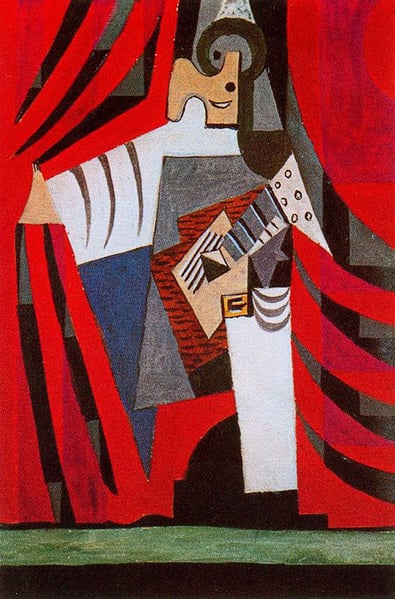
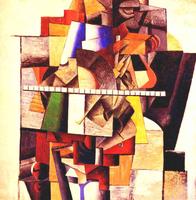
Punchinello with guitar
Details
Expertenanalyse zu Pablo Picassos Punchinello with guitar
Stil: Cubism · Genre: genre painting
Expert Analysis of "Punchinello with guitar" by Pablo Picasso
Pablo Picasso’s Punchinello with guitar is a striking example of his ability to fuse multiple stylistic currents within a single work. Created during his Neoclassicist & Surrealist Period (circa 1920s–1930s), the painting is classified as Cubism in style and falls within the genre painting tradition—a depiction of everyday life or theatrical characters. This combination makes the artwork significant for several reasons:
1. Thematic Synthesis of Tradition and Modernity
Punchinello, a stock character from the commedia dell’arte, represents the timeless, grotesque clown—a recurring motif in Picasso’s oeuvre. By portraying this figure with a guitar, Picasso bridges the gap between classical theatrical archetypes (a nod to his Neoclassical interests) and the fragmented, abstracted forms of Cubism. The result is a genre scene that feels both ancient and radically modern.
2. Cubist Treatment of Form and Space
Despite being rooted in a later period, the work retains core Cubist principles: the guitar and figure are broken into geometric facets, with multiple perspectives flattened onto a single plane. This deconstruction of the human form—particularly the clown’s elongated limbs and mask-like face—creates a dynamic tension between recognizable subject and abstract geometry. The guitar, a common Cubist prop, serves as both a musical object and a structural element anchoring the composition.
3. Surrealist Undertones of Psychological Depth
While Cubist in style, the painting’s Surrealist period context infuses it with dreamlike ambiguity. Punchinello’s distorted proportions and vacant, mask-like expression hint at the subconscious—a nod to Picasso’s engagement with Surrealist ideas of the irrational and the grotesque. The guitar, often a symbol of artistic creation, becomes a vessel for both playful melody and existential dissonance.
4. Significance Within Picasso’s Career
Punchinello with guitar exemplifies Picasso’s refusal to be confined to a single movement. It marks a transitional moment where the rigid geometries of early Cubism soften into more organic, surreal forms, while still retaining the analytical structure that defined his revolutionary style. The work stands as a testament to Picasso’s lifelong dialogue with art history, popular culture, and the avant-garde.
Conclusion
This painting is significant as a genre scene that encapsulates Picasso’s mature synthesis: the Neoclassical love of timeless characters, the Cubist breaking of visual conventions, and the Surrealist probing of the psyche. It demonstrates how Picasso could take a playful, often lowbrow subject and elevate it into a complex meditation on form, identity, and artistic tradition.
Visuell ähnlich
20 Werke mit ähnlicher Komposition und Farbpalette
The Bottle of Marc
Georges Braque
Harlequin
Pablo Picasso
Guitar
Pablo Picasso
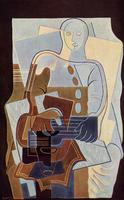
Pierrot with Guitar
Juan Gris
The Musician
Georges Braque
Pedestal Table in front of the Window
Juan Gris
Guitar on pedestal
Pablo Picasso
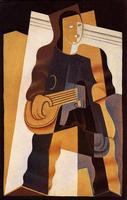
Pierrot
Juan Gris
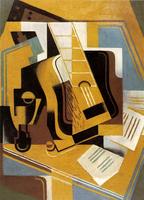
Photograph of The Guitar
Juan Gris
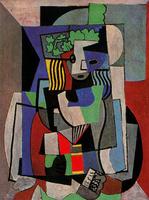
The student
Pablo Picasso
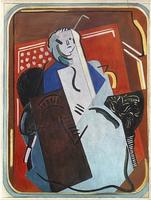
Femme au Fauteuil
Albert Gleizes
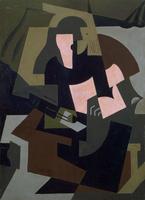
Woman with Guitar
Maria Blanchard
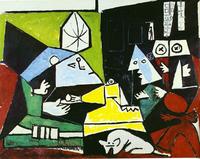
Las Meninas (Velazquez)
Pablo Picasso
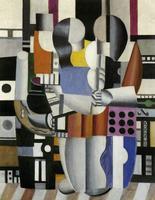
Three figures
Fernand Leger
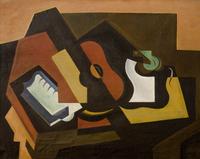
Naturaleza Muerta a La Guitarra
Maria Blanchard
The Accordion Player
Gino Severini
Woman with a Mandolin (after Corot)
Juan Gris
Composición Con Personaje
Maria Blanchard
The Man with the cane
Fernand Leger
Portrait of M.V.Matyushin
Kazimir Malevich