
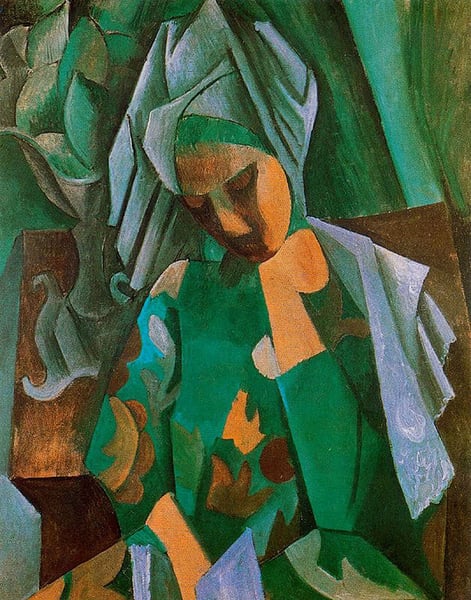
Pablo Picasso sanatçısının Queen Isabella eseri hakkında uzman analizi
Tarz: Cubism · Tür: portrait
Expert Analysis of "Queen Isabella" by Pablo Picasso
This portrait represents a crucial transitional moment in Picasso’s oeuvre, where the raw energy of his African Period meets the nascent language of Cubism. Though the subject is a historical monarch, Picasso treats her not as a naturalistic likeness but as a structural problem to be solved through radical abstraction.
Significance within Style and Period:
-
African Influence Reconceived – The face of Isabella likely displays the hallmark features of Picasso’s African Period: heavy-lidded, asymmetrical eyes, a broad nose, and simplified, mask-like planes. These elements, derived from Iberian sculpture and Fang masks, strip the queen of regal idealism, giving her a primal, confrontational presence. This was Picasso’s way of “civilizing” a European subject with non-Western formal tools.
-
Proto-Cubist Spatial Distortion – Though not yet fully Cubist (which would fragment the picture plane into multiple perspectives), this portrait already shows a shift away from Renaissance perspective. The face may be rotated slightly away from a strict profile or front view, hinting at the simultaneous viewpoints that define Analytical Cubism. The background is likely flattened and geometric, compressing Isabella into the picture plane.
-
Reimagining Portraiture – Portraits of royalty traditionally emphasized dignity via illusionistic realism. Picasso subverts this by turning Isabella into a faceted, almost totemic figure. Her identity as a queen is neither sentimentalized nor idealized; instead, she becomes a vehicle for exploring form, volume, and the tension between representation and abstraction.
-
Historical Context – The painting sits at the cusp of Picasso’s breakthrough. Begun in the wake of Les Demoiselles d’Avignon (1907), it shares that work’s aggressive mask-like faces. But here, applied to a single figure, the focus is tighter. The African Period’s energy is being channeled into a more controlled, yet equally radical, portrait.
Conclusion:
“Queen Isabella” is significant as a document of Picasso’s path to Cubism—a moment when African art’s plastic power was still dominant, yet the seeds of geometric analysis had already been sown. It challenges the very idea of a “royal portrait” by replacing hierarchy with primitivist intensity and formal invention.
Museum / Gallery
Görsel olarak benzer
İlişkili kompozisyon ve renk paletine sahip 20 eser
Gitane Endormie (sleepy Gypsy)
Robert Falk
Anna Margit, Nő Csokorral
Anna Margit
Girl with a Fish Bowl
August Macke
Mujer Sentada
Maria Blanchard
Mother's Portrait
Minas Avetisyan
Harlequin leaning
Pablo Picasso
Head of a Woman
Georges Braque
Czóbel Béla Mimi
Bela Czobel
Old Woman with a Ball of Yarn
Marc Chagall
Turk Women
Iosif Iser
WOMAN WITH BABY
Gerard Sekoto
Annie Bjarne
Amedeo Modigliani
Odaliscă
Samuel Mutzner
Harlequin's family
Pablo Picasso
Female portrait
Oleksandr Bogomazov
Interior with Woman
Alexandru Ciucurencu
Hélène
Alexej von Jawlensky
Scheiber Hugó, Bárban, ,.
Scheiber Hugó
Portrait of a Woman in Pink
Robert Falk
Models
Rudolf Bér