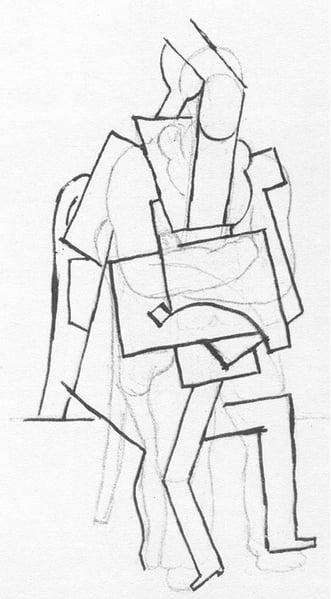
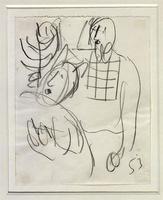
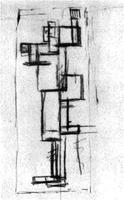
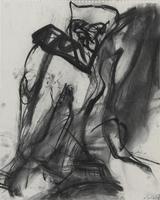
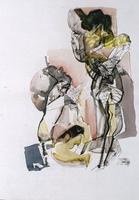
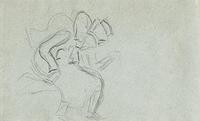
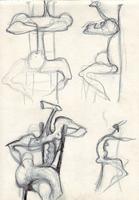
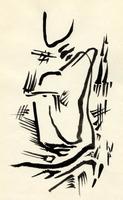
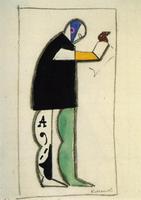
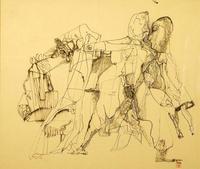
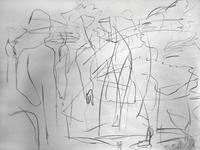
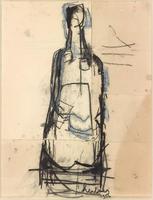
As an expert art historian, I will analyze "Seated man with his arms crossed" by Pablo Picasso based solely on the provided structured facts.
This artwork is significant within the Cubist Period because it exemplifies Picasso’s working method during a revolutionary phase of modern art. As a sketch and study in the Cubism style, the piece reveals the artist’s process of deconstructing the human figure into geometric planes and shifting perspectives—hallmarks of the movement. The subject, a seated man with crossed arms, is a familiar, static pose, but through a Cubist lens it becomes a dynamic exploration of form and space. The very fact that this is a study—not a finished painting—underscores the experimental nature of Cubism: Picasso is testing how to represent three-dimensional volume and multiple viewpoints on a two-dimensional surface, stripping away color and detail to focus on structure and line. In this sense, the artwork serves as a critical document of how Picasso’s intellectual approach to form evolved during his Cubist Period, making it significant for understanding the foundation of one of art history’s most influential styles.