
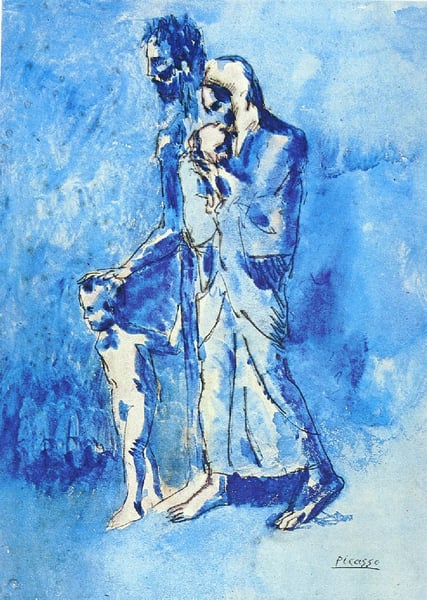
The family of blind man
Dettagli
Analisi esperta di The family of blind man di Pablo Picasso
Stile: Expressionism · Genere: genre painting
Expert Analysis: "The Family of Blind Man" by Pablo Picasso (Blue Period)
This work stands as a quintessential example of Picasso’s Blue Period (1901–1904), a phase defined by its somber monochromatic palette, themes of human suffering, and a deep, empathetic focus on marginalized individuals. Painted in 1903, “The Family of Blind Man” is a genre painting that elevates the everyday struggles of the impoverished into a universal, emotionally charged statement.
Significance within Expressionism and the Blue Period:
-
Emotional Intensity Through Color and Form – The painting is dominated by blue, blue-green, and grey tones, a deliberate choice that evokes coldness, sorrow, and psychological isolation. This limited palette is not merely stylistic but functions as an emotional amplifier, a hallmark of Expressionism. The figures are elongated and gaunt, their bodies compressed into a shallow space, creating a sense of claustrophobia and despair.
-
The Blind Father as Metaphor – The central figure, a blind man, represents both literal and metaphorical blindness—to hope, to a better future. His sunken eyes and downward gaze convey complete withdrawal from the world. The family clinging to him—the woman and child—are physically near yet emotionally distant, their touches tentative rather than comforting. This tension between proximity and isolation is a poignant commentary on the plight of the poor in early 20th-century Spain.
-
Melancholic Art of the Dispossessed – Unlike Picasso’s later Cubist experiments, this Blue Period work focuses on raw, unidealized human misery. The family’s bundled, defenseless postures and their sallow, undifferentiated flesh emphasize their vulnerability. The lack of distinguishable facial features (especially the blind man’s blank stare) universalizes their suffering, making the painting a powerful social statement about poverty, disability, and alienation.
-
Transition from Academic to Modern – While still retaining some academic figuration, “The Family of Blind Man” marks a decisive break from naturalism. The expressive distortion of anatomy and the near-abstract handling of shadow exemplify Picasso’s move toward modernism, where feeling outweighs realism. This painting foreshadows the emotional depth that would later define Expressionist portraiture.
Conclusion:
This work is significant because it crystallizes the Blue Period’s core achievement: transforming personal melancholy into a universal, empathetic visual language. Through its stark color, distorted forms, and profound sense of isolation, “The Family of Blind Man” transcends its specific subject to become a timeless meditation on human fragility and the dignity of those society has forgotten. It is a cornerstone of Picasso’s early career and a masterpiece of early Expressionist genre painting.
Visivamente simili
20 opere con composizione e palette affini
Group of poor people
Pablo Picasso
Famine Sketch
Zainul Abedin
Femme de Profil et Trois Enfants
Theophile Steinlen
La crucifixion
Paul Ackerman
Saint Agnes
Adam Elsheimer
Cikáni
Josef Capek
Mother, child saving
Kuzma Petrov-Vodkin
As pombas
Julio Resende
The Expulsion
Alexander Bogen
Madonna with Garland
Pablo Picasso
Noli me tangere (John 20:1)
Salvador Dali
Killed in Action
Kathe Kollwitz
Images of the war
Alberto Sughi
La Famille Indigente
Theophile Steinlen
Famine Series
Zainul Abedin
Allegory of Fertility
Jacob Jordaens
Untitled
Kateryna Lysovenko
A Woman's Shadow
Balcomb Greene
Gypsy woman with two children
August von Pettenkofen
Saint Helen
Adam Elsheimer