
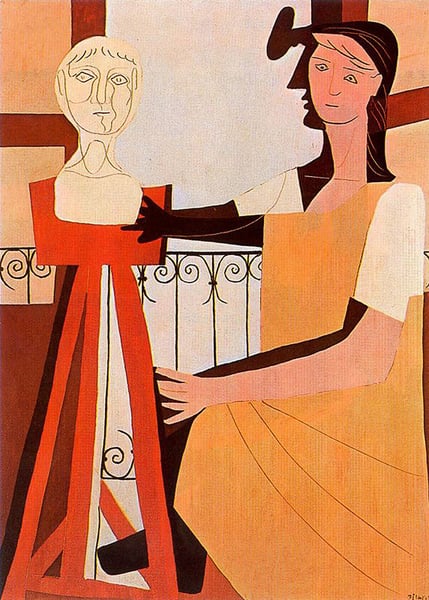
Expertenanalyse zu Pablo Picassos The sculpture
Stil: Cubism, Surrealism · Genre: genre painting
Expert Analysis: "The Sculpture" by Pablo Picasso
This work occupies a pivotal intersection in Picasso’s career, emerging during his Neoclassicist & Surrealist Period (roughly 1917–1937). While the title suggests a three-dimensional object, the piece is here classified as a genre painting—a scene of everyday life—which immediately signals Picasso’s subversion of expectations. Its stylistic fusion of Cubism and Surrealism is what makes it historically significant.
1. Dual Stylistic Language: From Cubism, Picasso retains the fractured planes, multiple viewpoints, and geometric restructuring of space. The sculpture depicted is likely rendered with faceted surfaces and shifting perspectives, referencing his own Cubist sculptures (e.g., Guitar, 1912). Yet the dreamlike, irrational juxtapositions characteristic of Surrealism—an influence he absorbed after his involvement with the Surrealist movement in the mid-1920s—imbue the figure with a sense of metamorphosis and psychological tension. The artwork becomes a painted meditation on the very act of sculpting, blurring the boundary between representation and reality.
2. Genre Inversion: By presenting a sculpture within a genre painting, Picasso challenges the hierarchy of artistic subjects. Genre painting traditionally depicts ordinary people in domestic settings; here, the “ordinary” is replaced by an art object, questioning what constitutes daily life for an artist. This meta-commentary aligns with Surrealism’s interest in the unconscious and the artist’s studio as a site of creation and fantasy.
3. Period Context: During his Neoclassicist phase (early 1920s), Picasso had adopted monumental, classical forms reminiscent of Ingres. In The Sculpture, he retains a tactile, voluminous mass—traceable to that Neoclassicism—yet dissolves it with Cubist fragmentation and Surrealist biomorphism. The work thus encapsulates his transition from a structured, antique-inspired aesthetic to a more fluid, psychological one, bridging the two movements that defined modernism.
Significance: The Sculpture exemplifies Picasso’s ability to synthesize opposing ideologies—order and chaos, tradition and innovation, two-dimensional painting and three-dimensional sculpture. It stands as a key transitional piece, demonstrating how Cubism’s analytical rigor provided a foundation for Surrealism’s liberation of the creative subconscious. This artwork is not merely a depiction of a statue; it is a manifesto of artistic hybridity, reflecting Picasso’s relentless reinvention and his profound impact on the trajectory of 20th-century art.
Visuell ähnlich
20 Werke mit ähnlicher Komposition und Farbpalette
Female Painter
Milton Avery
The Painter and His Model
Georges Braque
Shrine. Homage to Cézanne
Miriam Schapiro
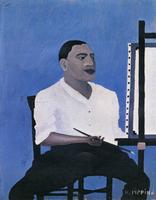
Self-Portrait
Horace Pippin
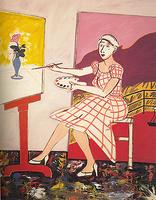
Self-Portrait
Joan Brown
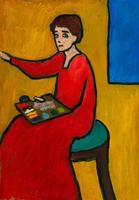
Beim Malen (wohl Marianne von Werefkin)
Gabriele Munter
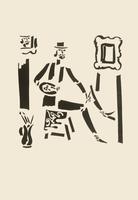
Linocut
Vytautas Kasiulis
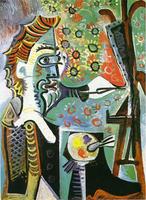
An artist
Pablo Picasso
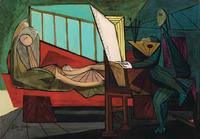
Le Peintre et son Modèle
Oscar Dominguez
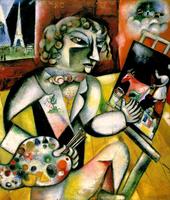
Self-Portrait with Seven Digits
Marc Chagall
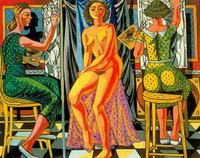
Painters and Model
Rafael Zabaleta
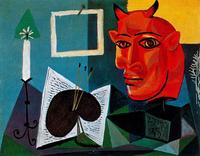
Candle, palette, head of red bull
Pablo Picasso
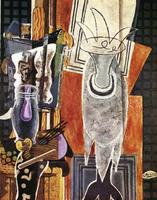
The Pedestal
Georges Braque
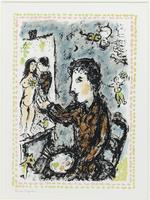
Scene in studio
Marc Chagall

SELF PORTRAIT
Cricorps
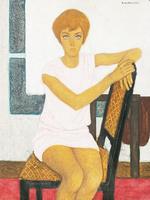
Czene Béla, Rózsaszin Ruhás Lány,
Czene Béla
The Three O'Clock Sitting
Henri Matisse
Interior with nude
Rafael Zabaleta
Elizabeth Siddal Seated at an Easel
Dante Gabriel Rossetti
Bela Czene, Sitting Women
Czene Béla