
Description
Style: High Renaissance · Genre: mythological painting
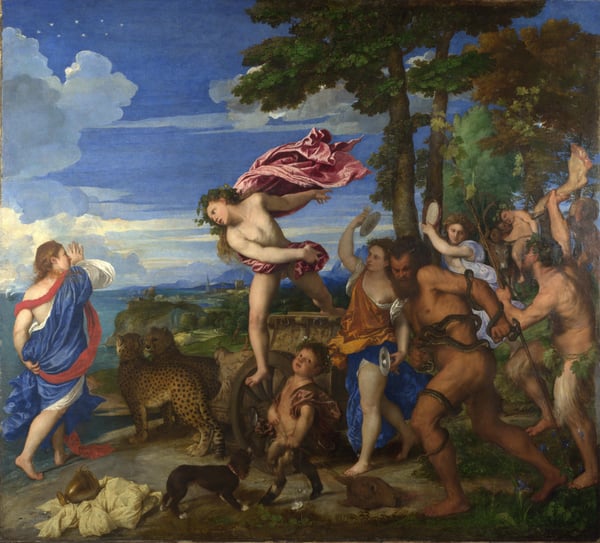
This colorful history painting (also known as a poesie) is one of a cycle of mythological pictures based on classical texts which were commissioned by Alfonso I d'Este, Duke of Ferrara, for his Camerino d'Alabastro – a private chamber in his ducal palace in Ferrara. This work - a substitute for one by Raphael - was one of three provided by Titian between 1518 and 1525. The other two are Worship of Venus (1518-1519) and Bacchanal of the Andrians (1523-1525), both now in the Prado Museum, Madrid.
Derived from stories by the Roman poets Ovid and Catullus, this picture portrays the first encounter between Bacchus (god of wine), and Ariadne (daughter of King Minos), on the island of Naxos. Despite her vital role in helping Theseus to defeat the minotaur, Ariadne has been deserted by her lover, whose ship can be seen (far left of the picture) sailing away into the distance. As she watches the ship depart, her sorrow is suddenly interrupted by the arrival of Bacchus and his unruly troupe of drunken friends, one of whom (a satyr) is waving aloft the head of an animal they have just killed (its head is lying on the ground). When the startled Ariadne turns to face the revelers, she sees Bacchus leaping from his chariot and their eyes meet: it is love at first sight. Bacchus leaps down from his chariot, drawn by two cheetahs, and declares his love. He promises to be a more faithful partner than Theseus and offers her a constellation of stars (Corona Borealis, the Northern Crown) as a wedding gift. Other versions have Bacchus raising her to heaven and transforming her into a constellation, represented by the eight stars above her.
Titian manages to extract the maximum amount of drama out of the story, mainly through the dynamic postures adopted by his two main actors. But equally important are their swirling draperies with their luminous blue and rose tones - Titian's two favorite colors. At any rate, the composition is filled with movement and color, as semi-naked figures writhe and cavort in poses taken from Greek sculpture of classical antiquity, such as the satyr who is struggling with snakes in a similar fashion to that shown in the Greek statue Laocoon and His Sons (c.125 BC). A diagonal dividing line separates the golds and greens of the landscape scene from the broad area of ultramarine blue (obtained by grinding the most expensive of all color pigments - the Afghanistan-mined lapis lazuli).
Museum / Gallery
Visually similar
20 works with related composition and palette
Bacchus and Ariadne
Luca Giordano
The Bacchanal of the Andrians
Titian
The Bacchanal of the Andrians
Peter Paul Rubens
Mars and Venus
Nicolas Poussin
Apollon Och Dafne
Placido Costanzi
Venus Presenting Arms to Aeneas
Nicolas Poussin
La Déification D'enée
Charles Le Brun
Apollo and Daphne
Jean-Baptiste van Loo
The Deification of Aeneas
Charles Le Brun
Bacchanal Before a Statue of Pan
Nicolas Poussin
The Triumph of Silenus
Nicolas Poussin
Series of the Four Parts of the World. America
Luca Giordano
Venus and Adonis
Ferdinand Bol
Father Time Overcome by Love, Hope and Beauty
Simon Vouet
The Triumph of Flora
Nicolas Poussin
Pan and Syrinx
Nicolas Poussin
Apollo and Daphne
Nicolas Poussin
Venus and Adonis
Paolo Veronese
Diana and her Nymphs
Domenichino
Pythagoras Advocating Vegetarianism
Peter Paul Rubens