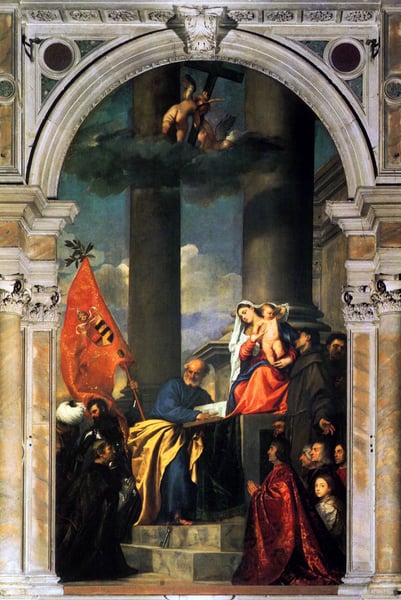
Analysis of "The Madonna of the Pesaro Family" by Titian
As an expert art historian, I focus on the significance of this work within the High Renaissance—a style defined by balance, naturalism, and monumental harmony—and its genre as a religious painting. Titian, a master of the Venetian school, elevates the altarpiece tradition through a bold compositional innovation that is directly indicated by the artwork's title: the inclusion of the Pesaro family donor portraits within the sacred scene. This integration of earthly patrons with the divine Madonna marks a departure from the strict symmetry of earlier High Renaissance compositions, creating a dynamic, diagonal arrangement that draws the viewer's eye across the canvas. The religious subject—the Madonna and Child with saints—is treated with a new sense of immediacy and earthly presence, while Titian's handling of color and atmosphere (characteristic of Venetian High Renaissance painting) infuses the scene with a luminous, unified space. This work is significant for its pioneering fusion of portraiture, architectural space, and sacred narrative, demonstrating how the High Renaissance continued to evolve by embracing greater naturalism and compositional freedom, all while maintaining the period's commitment to idealized beauty and spiritual resonance.