Analisi esperta di Saint Christopher di Titian
Stile: High Renaissance · Genere: religious painting
This analysis draws exclusively on the provided facts—artist (Titian), style (High Renaissance), genre (religious painting)—and established art-historical knowledge of that period and subject.
Expert Analysis of Saint Christopher by Titian
As a High Renaissance religious painting by Titian, Saint Christopher exemplifies the era’s shift from static, icon-like devotional images to dynamic, human-centered narratives. Within the context of Titian’s oeuvre, this work stands as a masterful synthesis of sacred storytelling and naturalistic vitality—a hallmark of the High Renaissance.
Significance within the High Renaissance Style:
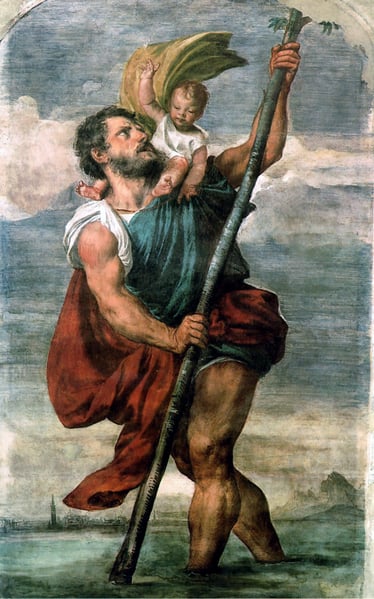
The High Renaissance prized balanced composition, anatomical precision, and the illusion of three-dimensional space. Titian, a Venetian master, brought to this a revolutionary use of color and atmospheric light (the colore tradition). In Saint Christopher, these traits would manifest in the rendering of the giant Christopher’s muscular form, the flowing drapery that defines his movement through water, and the soft landscape that recedes into a luminous distance. The interaction between the colossal saint and the Christ child on his shoulders is both physically plausible and spiritually charged—a testament to the period’s desire to make the divine feel tangibly present.
Religious Genre & Iconography:
Saint Christopher was a popular subject for wayfarers and pilgrims. Titian’s treatment elevates the legend from mere miracle tale to a human drama of burden and faith. The saint’s strain and the Christ child’s serene weight convey a theological message: carrying Christ through the world’s currents requires both strength and humility. The scale of the figure relative to the landscape—monumental yet grounded—reflects the High Renaissance fascination with man’s place in a grand, ordered cosmos.
Titian’s Artistic Contribution:
As a leading figure of the Venetian High Renaissance, Titian infused religious subjects with sensuous color, emotional depth, and a sense of fleeting moment. In Saint Christopher, this would likely be seen in the warm, flesh tones against cool water, the dramatic diagonal of the staff and body, and the way light models the figures with a soft, atmospheric glow—techniques that later influenced Baroque painting. The work thus represents a bridge between the idealization of the early High Renaissance and the more expressive, dynamic art of the coming era.
In sum, Saint Christopher is significant not only as a devotional image but as a demonstration of how High Renaissance artists transformed religious iconography into a vehicle for exploring human emotion, natural beauty, and the sublime presence of the divine—all anchored in Titian’s peerless command of color and composition.
Museum / Gallery
Visivamente simili
20 opere con composizione e palette affini
[Unkown]
Basilio Santa Cruz Pumacallao
St. Christopher
Lorenzo Lotto
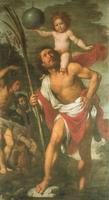
St. Christopher, St. Sebastian, St. Roch
Bernardo Strozzi
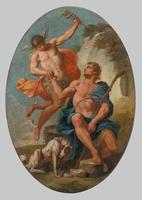
Mercury and Paris
Heinrich Schonfeld
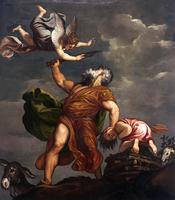
Sacrifice of Isaac
Titian
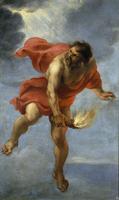
Prometheus Carrying Fire
Jan Cossiers
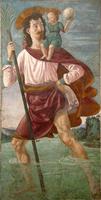
St. Christopher
Domenico Ghirlandaio
St Matthew
Paolo Veronese
The Sacrifice of Isaac
Tintoretto
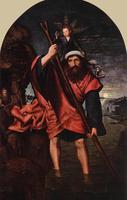
St Christopher
Quentin Matsys
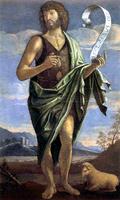
John the Baptist
Bartolomeo Veneto
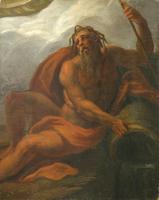
Neptune
James Thornhill
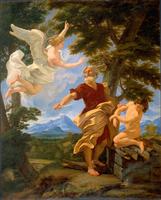
Abraham's Sacrifice of Isaac
Giovanni Battista Gaulli
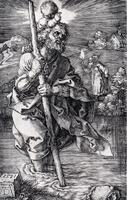
St. Christopher facing right
Albrecht Durer
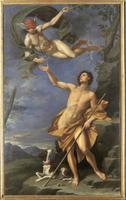
Mercury and Paris
Donato Creti
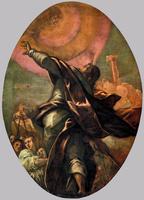
The Pillar of Fire
Tintoretto
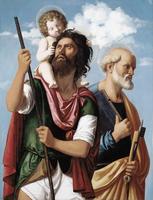
St. Christopher with the Infant Christ and St. Peter
Cima da Conegliano
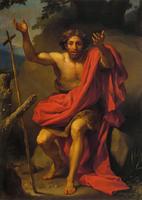
Saint John the Baptist Preaching
Anton Raphael Mengs
San Juan Bautista
Francisco Pacheco
St. John the Baptist
El Greco