
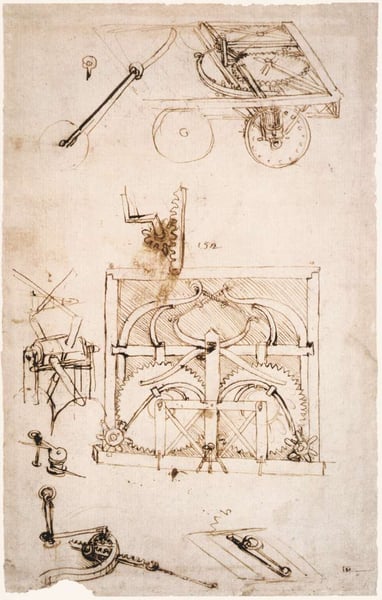
Analyse experte de Automobile de Leonardo da Vinci
Style : Early Renaissance · Genre : design
Expert Analysis: "Automobile" by Leonardo da Vinci
Leonardo da Vinci’s “Automobile” is not a finished painting or sculpture but a visionary design sketch dating to the Early Renaissance, a period that otherwise celebrated religious narrative, perspective, and naturalism. Yet this drawing is profoundly significant precisely because it demonstrates the era’s emerging fusion of artistic observation with scientific inquiry—a hallmark of da Vinci’s genius.
Genre and Intention
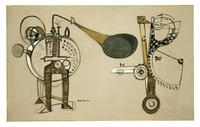
Classified under the genre of design, this work is an engineering concept for a self-propelled vehicle, often considered a forerunner to the modern automobile. It belongs to da Vinci’s codices (especially the Codex Atlanticus), where he recorded mechanical inventions alongside anatomical studies and architectural plans. The drawing shows a simple wooden cart powered by coiled springs and a gear system—a prototype meant to move without horses or human pushing.
Stylistic Significance within Early Renaissance
Although the Early Renaissance is typically associated with Giotto, Masaccio, or Botticelli’s altarpieces, da Vinci’s sketches reveal a crucial parallel development: the application of classical reason and empirical observation to technology. The “Automobile” embodies the Renaissance ideal of the uomo universale—the universal human who masters both art and science. The sketch is rendered in precise, linear pen-and-ink, showing da Vinci’s command of proportion and mechanical logic, much as his paintings show mastery of human anatomy.
Why It Matters
- Technical Pioneering: The design uses a geared rack-and-pinion mechanism, a differential (to allow the front wheels to steer), and a spring motor—concepts centuries ahead of their time.
- Concept of Automation: It reflects a growing Renaissance curiosity about reducing human labor through machinery, a theme that would later fuel the industrial revolution.
- Interdisciplinary Vision: Like his Vitruvian Man, this drawing bridges art and engineering. It is not merely a blueprint but a work of conceptual beauty—a testament to how Renaissance artists saw design as a legitimate intellectual pursuit.
Conclusion
Leonardo’s “Automobile” is significant not as a finished object but as a window into the Early Renaissance mind. It challenges the narrow definition of “art” and expands the period’s legacy to include visionary design. In its blend of aesthetic clarity, mechanical logic, and forward-looking ambition, it encapsulates the very spirit that made the Renaissance a turning point in Western thought: the belief that observation, creativity, and reason could reshape the world.
Museum / Gallery
Visuellement similaire
20 œuvres à la composition et à la palette proches
Sketches of the machines
Filippo Brunelleschi
Sketches of the machines
Filippo Brunelleschi
Drawings of Water Lifting Devices
Leonardo da Vinci
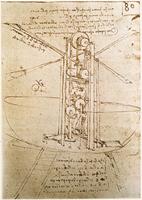
Flying machine
Leonardo da Vinci
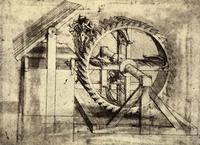
Crossbow Machine
Leonardo da Vinci
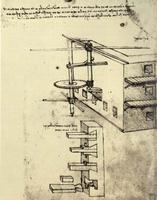
Siege Defenses
Leonardo da Vinci
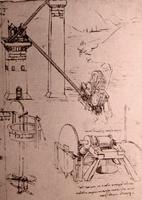
Drawings of machines
Leonardo da Vinci
Design for a machine for grinding convex lenses
Leonardo da Vinci
Love Parade
Francis Picabia
Multi Barrel Gun
Leonardo da Vinci
Exlibris of B.Solman
Oleksandr Aksinin
Drill
Frantisek Kupka
Love Parade
Francis Picabia
Composition
Fernand Leger
Untitled 15
Ikhwan Sugianto
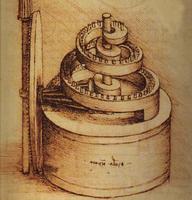
Spring Device
Leonardo da Vinci
Machine Turn Quickly
Francis Picabia
Le Démon Du Saturne
Anton Prinner
Gears
Thomas Eakins
Antro II
Hedda Sterne