Expertenanalyse zu Leonardo da Vincis Grotesque Profile
Stil: Early Renaissance · Genre: sketch and study
Expert Analysis of "Grotesque Profile" by Leonardo da Vinci
Context and Purpose
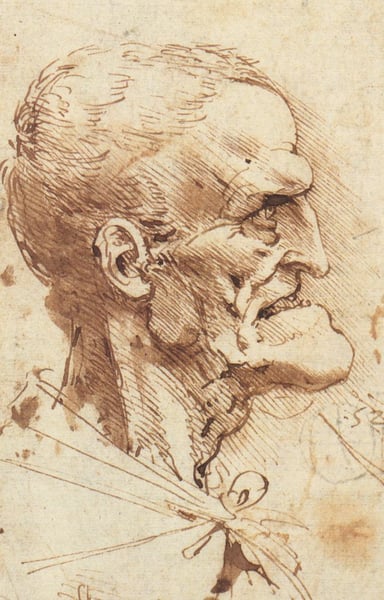
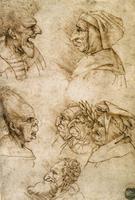
Executed in pen and ink on paper, Grotesque Profile exemplifies Leonardo da Vinci’s lifelong fascination with human physiognomy and the boundaries of natural form. During the Early Renaissance, artists increasingly turned to direct observation of nature, but Leonardo pushed this further by systematically recording both ideal beauty and exaggerated, even distorted features. This sketch belongs to a series of “grotesque heads” that Leonardo produced from the 1480s onward—studies that were not mere caricatures but analytical investigations into how age, emotion, and physical anomaly alter facial structure.
Stylistic Significance
Within the Early Renaissance context, Leonardo’s approach was revolutionary. While contemporaries like Botticelli or Ghirlandaio focused on harmonious, idealized figures, Leonardo deliberately explored the irregular and the extreme. In Grotesque Profile, the subject’s elongated chin, bulging brow, and exaggerated nose are rendered with the same meticulous hatching and volumetric modeling that he applied to his most refined portraits. This equivalence of treatment—treating the grotesque with the same scientific curiosity as the beautiful—underscores a core Renaissance principle: all aspects of nature, even the bizarre, are worthy of study.
Art Historical Impact
The significance of this work lies in its role as a preparatory study for larger compositions (such as the Adoration of the Magi) and as a standalone exploration of character and deformity. Leonardo’s grotesques later influenced Northern Renaissance artists like Quentin Matsys and, through printed copies, became a template for physiognomic studies across Europe. They also reveal Leonardo’s belief that character could be read through facial features—a proto‑physiognomic theory that anticipated later scientific inquiries.
Conclusion
Grotesque Profile is not a marginal curiosity but a testament to Leonardo’s relentless empiricism. By elevating the sketch—the informal, private study—to a document of serious inquiry, he expanded the scope of Renaissance art beyond idealization into a comprehensive, non‑judgmental record of human diversity. It stands as a key example of how Early Renaissance humanism, combined with naturalistic observation, could embrace both the sublime and the strange.
Visuell ähnlich
20 Werke mit ähnlicher Komposition und Farbpalette
Profile of an old man
Leonardo da Vinci
Study for the Last Supper: Judas
Leonardo da Vinci
Head of man
Hans Baldung
Study for a Male Head
SM Sultan
Five Grotesque Heads
Francesco Melzi
Five caricature heads
Leonardo da Vinci
Head of a Pope
Albrecht Durer
Doña Peppa Mattiocco
John Peter Russell
Study of an Old Man
Leonardo da Vinci
Head of Suvorov
Vasily Surikov
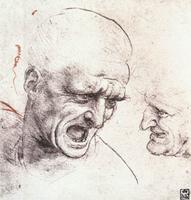
Studies for the heads of two soldiers in 'The Battle of Anghiari'
Leonardo da Vinci
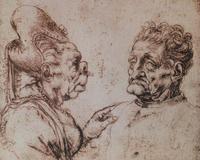
Caricature
Leonardo da Vinci
Head of a Man, Bareheaded
Vincent van Gogh
The Triple Face
Matthias Grünewald
Satyr's Head
Michelangelo
Old man`s head in profile
Giovanni Battista Piranesi
Head of an Old Man
Leonardo da Vinci
Bust of a man in profile with measurements and notes
Leonardo da Vinci
Seven caricatures
Francesco Melzi
Two Studies of the Head of an Old Man
Rembrandt