
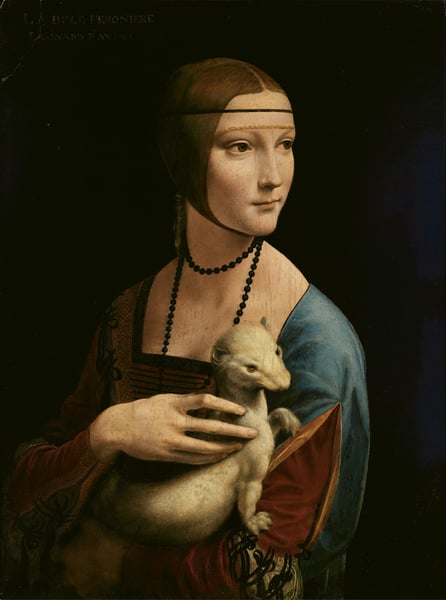
The Lady with an Ermine (Cecilia Gallerani)
Details
Description
Style: High Renaissance · Genre: portrait
The portrait Lady with an ermine (1489-1490) by Leonardo Da Vinci depicts Cecilia Gallerani, the teenage mistress of Ludovico Sforza, the regent and later the Duke of Milan. While some scholars doubted this identification, ample evidence affirms Cecilia Gallerani is the subject of Lady with an ermine. The earliest mention of the portrait appears in a sonnet by court poet Bernardo Bellincioni, in which he notes that it seems as if Cecilia is listening to an unseen speaker. Further confirmation exists in a correspondence between Cecilia and Isabella d’Este, the marquise of Mantua. In her letter, the marquise asks Cecilia to send her the portrait so she can compare Leonardo’s work to that of another master, Giovanni Bellini. Most importantly, the correspondence reveals that although Ludovico commissioned the painting, Cecilia owned it.
It is possible that because Cecilia was not of the highest rank, Leonardo allowed himself the freedom to break away from local conventions of portraiture. Most notably, he abandoned the local tradition of the profile portrait in favor of a three quarter view of the subject. Through the innovative pose Leonardo provoked the viewer’s curiosity and engaged them with the sitter of the portrait: she seems to be attentively gazing at something or someone out of view at the right side of the picture. The lady holds the ermine with her left hand, while her right hand elegantly caresses the animal’s shoulder. The suggestive hand gesture recurs in Leonardo’s later composition Leda and the Swan - even though the oil painting did not survive, the overall composition is known from drawings and oil copies made after Leonardo’s painting. In Lady with an ermine, Leonardo also demonstrated tremendous skill in his treatment of contrasting textures: the smooth skin next to the ermine’s fur, the carved jet-black beads against the chest and the intricately woven dress, the embroidered garment besides the smooth plain silk.
One of the key elements of the painting is the lively creature Cecilia holds in her arms. In fact, the symbolism of the ermine provides further evidence supporting the identification of Cecilia as the sitter. The ermine is a symbol of moderation and purity, and as such, its inclusion is appropriate for a portrait of a mistress of a Renaissance duke. Scholars also pointed to the fact that the Greek word for ermine is galé, thus it is a play on the Cecelia’s surname (Gallerani). Additionally, some have suggested that the ermine is an emblem associated to Ludovico, thus the ermine can be interpreted as an allusion to Cecilia’s lover.
Lady with an ermine was purchased in Italy around 1800 by the Polish Prince Adam Jerzy Czartoryski. He brought the painting to Poland, where he presented it to his mother, the Princess Izabella. The painting was incorporated into the family collection in Puławy, the museum founded by Princess Izabella in 1796. Today, it is the highlight of the collection at the Czartoryski Museum in Kraków, and is considered one of Poland’s national treasures.
Museum / Gallery
Visually similar
20 works with related composition and palette
Leonardo's Donna at the Mall
Zoe Marmentini
Mona Lisa's Chair
Octavio Ocampo
Loose woman 2
Sergei Parajanov
Compressed Museum. Mona Lisa
Alexander Roitburd
Mona Lisa
Blek le Rat
Compression of the Museum. Portrait of Madame Lisa Giocondo
Alexander Roitburd
Pieta
Sergei Parajanov
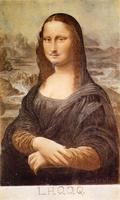
L.H.O.O.Q, Mona Lisa with moustache
Marcel Duchamp

Gazing Ball (da Vinci Mona Lisa)
Jeff Koons
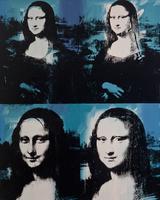
Mona Lisa Four Times
Andy Warhol
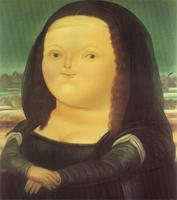
Mona Lisa
Fernando Botero

Portrait of an Unknown Woman (La Belle Ferroniere)
Leonardo da Vinci
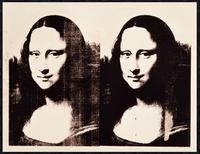
Double Mona Lisa
Andy Warhol
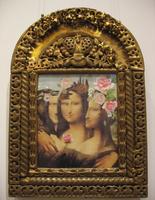
Triple portrait with Maya Plisetskaya and Vladimir Vysotsky
Sergei Parajanov

Mona Lisa
Alexandre Mury

Mona Lisa Sunset
Steve Kaufman
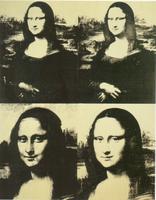
Mona Lisa
Andy Warhol
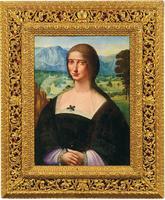
Portrait of unknown lady
Francesco Melzi
Cinétication
Pol Bury

iPod Belladonna
Zoe Marmentini