
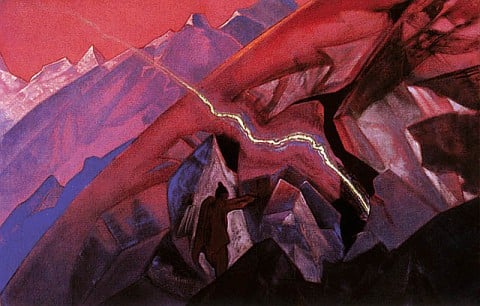
Expert analysis of Nicholas Roerich’s Arjuna
Style: Symbolism · Genre: mythological painting
Expert Analysis of "Arjuna" by Nicholas Roerich
Nicholas Roerich’s Arjuna stands as a quintessential example of Symbolist mythological painting, where the artist transcends mere narrative illustration to evoke a profound spiritual and philosophical dimension. Within the Symbolist movement—which prized inner vision, mysticism, and the evocation of transcendent truths over literal representation—Roerich’s treatment of this ancient Hindu figure becomes a vehicle for exploring universal themes of duty, destiny, and divine guidance.
Significance within the Symbolist Style
-
Myth as Inner Allegory: Symbolism often turned to myth and legend not for historical accuracy but as a language for the soul. Roerich’s Arjuna draws from the Bhagavad Gita, but the painting is less a depiction of the epic’s battlefield scene than a meditation on the moment of moral and spiritual crisis. The figure of Arjuna becomes an archetype of the seeker, poised between action and contemplation—a central Symbolist concern.
-
Atmospheric and Coloristic Mysticism: Roerich was renowned for his luminous, almost incandescent palette and his ability to make landscape itself a symbol. In Arjuna, the surrounding peaks, sky, and light are not mere background; they are charged with spiritual energy, suggesting the Himalayan heights as a metaphor for ascension, purity, and the meeting of earthly and cosmic realms. This use of color and atmosphere to convey inner states is a hallmark of Symbolist practice.
-
Integration of Eastern and Western Spiritual Currents: Roerich was a pioneering figure who synthesized Russian Symbolism with the philosophical traditions of India and the East. Arjuna exemplifies this cross-cultural dialogue, presenting a Hindu mythological figure through the lens of European Symbolist aesthetics. The work’s significance lies in its ability to communicate a universal spiritual quest, making ancient narrative resonate with contemporary Symbolist concerns about the nature of reality and the soul.
Significance as a Mythological Painting
-
Archetypal Representation: Unlike academic mythological paintings that often focus on dramatic action or heroic postures, Roerich’s Arjuna is still, introspective. This choice emphasizes the inner drama of the myth—the Arjuna who hesitates before battle, seeking counsel from Krishna. By freezing this moment of doubt and prayer, Roerich elevates the mythological figure into a symbol of all humanity standing at the crossroads of choice.
-
Cultural and Spiritual Synthesis: The work is significant for bridging two worlds: the rich mythological heritage of India and the Symbolist impulse to find hidden meanings in all cultures. Roerich treats the subject with reverence and esoteric insight, not as exotic decoration. Arjuna thus becomes a testament to the Symbolist belief that mythology contains timeless truths accessible through art.
In sum, Arjuna is a masterwork of Symbolist mythological painting because it moves beyond storytelling to become a visual mantra—a quiet, luminous meditation on the soul’s journey. Its significance lies in Roerich’s ability to fuse the ethereal aesthetic of European Symbolism with the profound spirituality of Eastern myth, creating an image that is at once culturally specific and universally resonant.
Visually similar
20 works with related composition and palette

Teacher's order
Nicholas Roerich

Captors of fire
Nicholas Roerich
Christ
Nicholas Roerich
Flying Carpet
Nicholas Roerich
Tibetian dwellings
Nicholas Roerich
Call of the Sky
Nicholas Roerich
Bogatyrs woke up
Nicholas Roerich

Oirot Messenger of the White Burkhant
Nicholas Roerich
Himalayas
Nicholas Roerich
The Souls of the Mountain
Remedios Varo

She who leads
Nicholas Roerich
Chenrezig
Nicholas Roerich
Kalki Avatar
Nicholas Roerich

Hunting
Nicholas Roerich
Starry sky
Nicholas Roerich

Silvery realm
Nicholas Roerich
Himalayas
Nicholas Roerich
Vision of the city
Mstislav Dobuzhinsky
Mohammed on mount Hira
Nicholas Roerich
Fire paternoster
Nicholas Roerich