
Analisi esperta di By the Brahmaputra di Nicholas Roerich
Stile: Symbolism · Genere: landscape
Expert Analysis: "By the Brahmaputra" by Nicholas Roerich
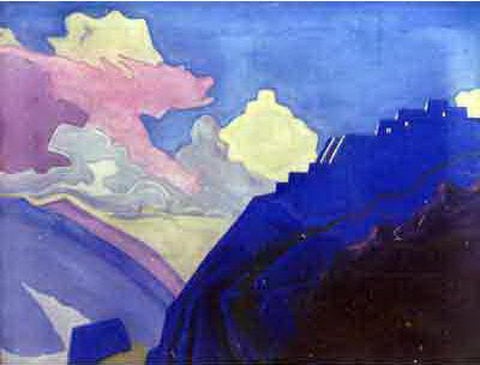
Nicholas Roerich’s By the Brahmaputra stands as a quintessential example of Symbolist landscape painting, where the natural world becomes a vessel for transcendent meaning. Created during the artist’s profound engagement with the Himalayas and Central Asia, this work transcends mere topographical depiction to evoke a spiritual and cosmic unity—a hallmark of Roerich’s mature style and the Symbolist movement’s emphasis on mood, mystery, and inner vision.
Significance within Symbolism and the Period
As a Symbolist work, By the Brahmaputra rejects literal representation in favor of suggestion. The Brahmaputra River, sacred in Hindu and Buddhist traditions, is not portrayed as a geographical feature but as a living, sacred force—a luminous artery of the soul. Roerich’s palette, dominated by icy blues, pale lavenders, and soft golds, creates an ethereal, almost otherworldly atmosphere. The river glows with an inner light, reflecting a sky that seems to merge with the water, dissolving the boundary between earth and heaven.
Composition and Symbolic Language
The composition is deliberately sparse and horizon-focused, typical of Roerich’s Himalayan landscapes. A low horizon line thrusts the monumental sky into prominence, while the river winds diagonally through the picture plane, guiding the viewer’s eye into a distant, hazy infinity. This directional flow suggests a journey—physical, spiritual, or both. The absence of human figures emphasizes the sublime isolation and power of nature. Instead, the viewer is invited to contemplate the landscape as a manifestation of the divine, a core concern of Symbolist philosophy.
Roerich’s Unique Contribution
What makes By the Brahmaputra particularly significant is Roerich’s fusion of Eastern spirituality with Western Symbolist aesthetics. Unlike his European contemporaries who often drew on mythological or decadent themes, Roerich anchored his symbolism in the actual landscapes he explored. His use of subtle, vibrating color harmonics and simplified, almost archaic forms gives the painting a timeless, iconic quality. The Brahmaputra, in Roerich’s hands, becomes a symbol of the eternal flow of life and consciousness—a river that is both physical and metaphysical.
Conclusion
In By the Brahmaputra, Roerich achieves what Symbolism aspired to: the transformation of a landscape into a state of being. It is a masterwork of quiet power, where the river’s silent current carries the weight of spiritual longing, and the light is not sunlight but an inner radiance of the mind. This painting exemplifies Roerich’s role as a visionary who used the natural world as a threshold to the sacred, securing his legacy as one of the most profound Symbolist landscape painters of the early 20th century.
Visivamente simili
20 opere con composizione e palette affini

Tashiding
Nicholas Roerich
Study of mountains
Nicholas Roerich

Defender. Cloud-archer.
Nicholas Roerich

Study to "Teacher's Testament'
Nicholas Roerich

Message from Shambhala
Nicholas Roerich

Himalayas. Gloomy cliff.
Nicholas Roerich

Tibet
Nicholas Roerich
Chan-La. Nek.
Nicholas Roerich

Tibet
Nicholas Roerich

Himalayas
Nicholas Roerich

Rohtang pass
Nicholas Roerich

Himalayas
Nicholas Roerich
Lahaul
Nicholas Roerich

Ramayana
Nicholas Roerich

Great spirit of Himalayas
Nicholas Roerich

Tibet. At Brahmaputra.
Nicholas Roerich
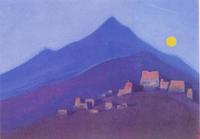
Moon over monastery in mountains
Nicholas Roerich

Himalayas
Nicholas Roerich

Tibetian dwellings
Nicholas Roerich

Himalayas
Nicholas Roerich