
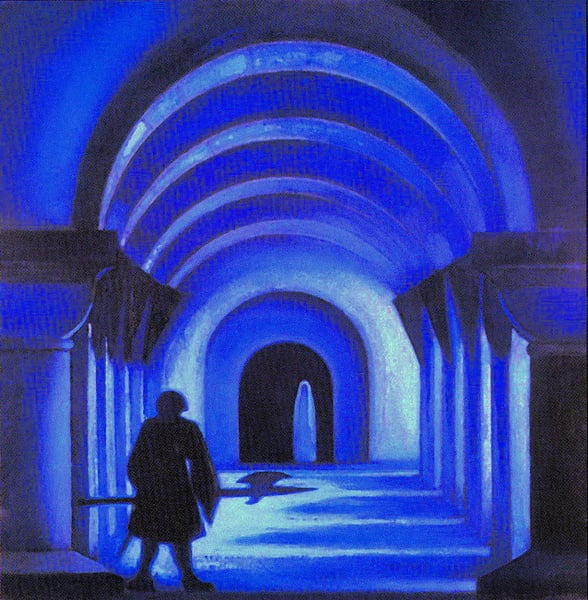
Chapel
Analisi esperta di Chapel di Nicholas Roerich
Stile: Symbolism · Genere: interior
Expert Art Historical Analysis: "Chapel" by Nicholas Roerich
Style Context: Symbolism
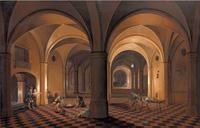
Nicholas Roerich’s "Chapel" stands as a quintessential example of Symbolist interior painting, a genre the artist used to transcend mere spatial representation and instead evoke spiritual transcendence. Within the Symbolist movement—which rejected naturalism for subjective, often mystical content—Roerich’s treatment of an interior space becomes a vessel for the unseen.
Significance of the Work
While the precise visual details of "Chapel" are not described in the provided facts, the work’s significance in the Symbolist canon lies in Roerich’s ability to transform a humble interior—a chapel—into a microcosm of cosmic and meditative meaning. Symbolist interiors were rarely about the literal room; they were psychological landscapes. In Roerich’s hands, the chapel’s walls, altar, and light sources would likely be simplified and intensified, stripping away anecdotal detail to focus on color, form, and the interplay of shadow and illumination. This approach aligns with Roerich’s broader spiritual philosophy, inspired by Eastern mysticism and the belief that art could bridge the material and the sacred.
The genre of “interior” here is elevated from documentation to allegory. The chapel is not merely a building but a threshold—an inner sanctuary where the viewer is invited to contemplate silence, prayer, or the eternal. The significance of "Chapel" within Roerich’s oeuvre and Symbolism at large is its demonstration of how the most intimate, enclosed spaces can suggest infinite depth. Through deliberate compositional economy and a palette likely dominated by deep blues, golds, or muted earth tones (as typical of Roerich’s sacramental interiors), the artist achieves a fusion of the earthly with the divine, a hallmark of Symbolist ambition.
In summary, "Chapel" is significant because it exemplifies Symbolism’s central goal: to render the invisible visible. Roerich achieves this by reimagining the interior genre not as a record of place, but as a catalyst for spiritual introspection.
Visivamente simili
20 opere con composizione e palette affini
Procession in Crypt
M.C. Escher
Tower of terror
Nicholas Roerich
Inner yard
Nicholas Roerich
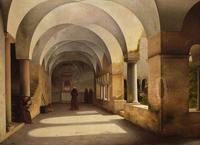
The Cloisters, San Lorenzo Fuori Le Mura
Christoffer Wilhelm Eckersberg
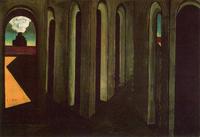
The anxious journey
Giorgio de Chirico
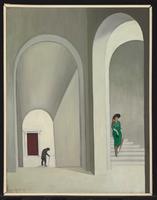
The Stairway
George Ault
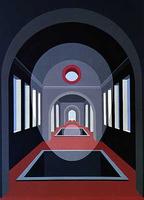
Transection #15
Clarence Holbrook Carter
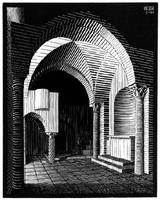
Porta Maria Dell' Ospidale
M.C. Escher
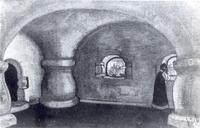
Room of Sadko
Nicholas Roerich
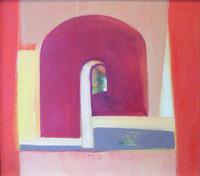
Antakya-Istanbul-Antakya XXXII
Artin Demirci
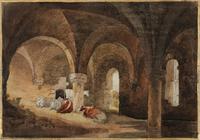
Crypt of Kirkstall Abbey (after J.M.W. Turner)
David Cox
Vignette for book "N. K. Roerich"
Nicholas Roerich
Castle
Nicholas Roerich
Through Eternity
Oronzo Vito Gasparo
The Entrance Hall of the Regensburg Synagogue
Albrecht Altdorfer
St. Severin, No. 3
Robert Delaunay
The Monastery of San Lorenzo Fuori le Mura (school of Eckersberg)
Christoffer Wilhelm Eckersberg
Farewell
Remedios Varo
Friar in prayer
Vincenzo Abbati
Liberation of Saint Peter
Pieter Neefs the Elder