
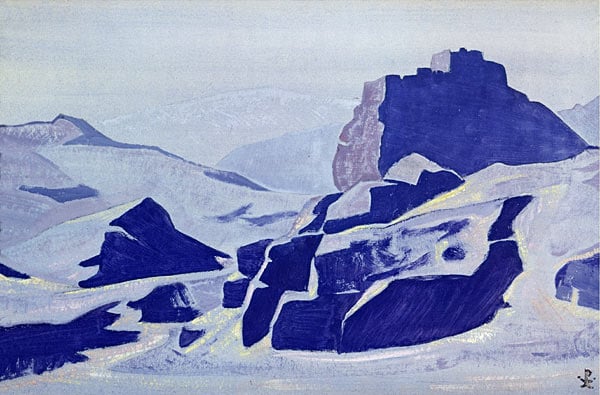
Analisi esperta di Dzong at evening di Nicholas Roerich
Stile: Symbolism · Genere: landscape
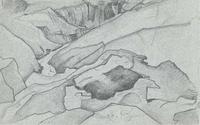
Expert Analysis: Dzong at Evening by Nicholas Roerich
Nicholas Roerich’s Dzong at Evening (c. 1930s) is a masterful example of Symbolist landscape painting, where the natural world becomes a vessel for spiritual and metaphysical meaning. Roerich, a Russian-born artist deeply influenced by Eastern philosophy and Theosophy, devoted much of his career to depicting the sublime grandeur of the Himalayas and the Tibetan plateau. This work is significant within his oeuvre and the Symbolist movement for several reasons.
1. Symbolist Transformation of Landscape
Unlike a mere topographical record, Roerich uses the evening light to evoke a sense of sacred timelessness. The dzong—a Tibetan fortress-monastery—rises as a geometric, almost crystalline form against the soft, fading glow of dusk. Symbolism here is conveyed through color and atmosphere: deep purples, blues, and warm golds merge, suggesting the liminal moment between day and night, the material and the spiritual. The landscape is not observed but felt, inviting contemplation of the unseen.
2. The Dzong as Archetype
The dzong itself is a potent symbol of spiritual protection and resilience. Roerich, who later lived in the Kullu Valley of India, saw these structures as earthly representations of the mythical Shambhala—a hidden kingdom of enlightenment. In Dzong at Evening, the fortress stands unwavering, its sharp silhouette contrasting with the soft, organic mountains. This juxtaposition embodies the Symbolist fascination with the eternal: the human-made structure is both part of nature and a gateway to higher realms.
3. Harmonic Color and Mood
Roerich’s palette in this piece is restrained yet luminous. The evening sky is layered with subtle transitions from indigo to pale gold, while the snow-capped peaks hold a cool, pearlescent light. Such tonal harmony is characteristic of his later work, where he synthesized Russian icon-painting traditions with the vivid hues of the East. The result is a meditative stillness that draws the viewer into a state of reverie—a hallmark of Symbolism’s aim to prioritize inner experience over outward reality.
Significance within Symbolism
Dzong at Evening exemplifies how Symbolist artists rejected naturalistic description in favor of conveying mood, mystery, and universal truths. Roerich’s unique contribution lies in his fusion of Western Symbolist aesthetics with Asian spiritual motifs, creating a cross-cultural vision of harmony. This painting not only captures the majestic silence of the Himalayas but also serves as a visual prayer—a threshold between the earthly and the divine. It remains a testament to Roerich’s belief that art should be a beacon of spiritual evolution, making Dzong at Evening a key work in the development of mystical landscape painting in the 20th century.
Visivamente simili
20 opere con composizione e palette affini
Town
Nicholas Roerich
View of the Himalayan Foothills
Nicholas Roerich
Castle of King Gesar
Nicholas Roerich
Monti di Grizzana
Giorgio Morandi

Mountain Crimea
Yuriy Khymych
Timur Khada
Nicholas Roerich
Himalayas (study)
Nicholas Roerich

Study to "Teacher's Testament'
Nicholas Roerich

Great spirit of Himalayas
Nicholas Roerich
A hill
Nicholas Roerich
Landscape
Jacobus Hendrik Pierneef

Basgo
Nicholas Roerich
Mist Before Dawn
Nicholas Roerich
Linnasaari, Ladoga lake
Nicholas Roerich
JH Pierneef - Landscape with Clouds - 1926
Jacobus Hendrik Pierneef
Gohtan mountains
Martiros Sarian
Arzni
Martiros Sarian
Monhegan (study)
Nicholas Roerich
Ruins of a Chinese fort
Nicholas Roerich
Rani Nulla river on Kulu side of Rohtang pass
Nicholas Roerich