Analisi esperta di Elbrus, Caucasus. di Nicholas Roerich
Stile: Symbolism · Genere: landscape
Expert Analysis: "Elbrus, Caucasus" by Nicholas Roerich
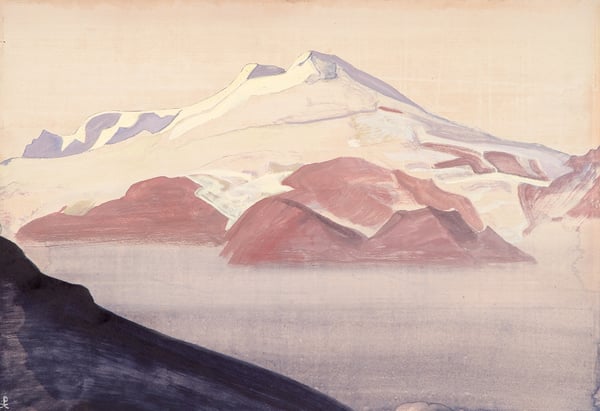
As a masterwork of Symbolist landscape painting, Elbrus, Caucasus exemplifies Nicholas Roerich’s ability to transform a specific geographic location into a transcendent, spiritual vision. Within the Symbolist movement—which prioritized inner emotion, mystical suggestion, and allegorical meaning over naturalistic depiction—Roerich’s treatment of Mount Elbrus, the highest peak in Europe, moves beyond mere topography to become a metaphor for the sublime and the eternal.
Significance within Symbolism and Roerich’s Oeuvre
-
Spiritual Transcendence through Landscape: Roerich was deeply influenced by Eastern philosophy, Theosophy, and the idea of mountains as sacred loci of spiritual energy. In this painting, Elbrus is not a picturesque summit but a luminous, almost otherworldly presence. The mountain dominates the composition with stark, simplified forms and a palette of cool blues, whites, and muted earth tones that evoke purity, silence, and cosmic stillness. This aligns with Symbolism’s rejection of material reality in favor of metaphysical essence.
-
Atmospheric Color and Light: Roerich employs a distinctive, subdued color harmony—soft lavenders, pale golds, and icy blues—to create an aura of mystery and reverence. The light appears both natural and internal, as though emanating from the mountain itself. This technique blurs the boundary between day and twilight, between the physical world and a dreamlike state. Such handling of color is a hallmark of Roerich’s mature style and a key to his contribution to Symbolist landscape painting.
-
Cultural and Geographical Symbolism: The Caucasus region held particular significance for Roerich, who saw it as a crossroads of ancient cultures and a repository of mythological memory. By choosing Elbrus—a dormant volcano and the legendary site of Prometheus’s chaining—he layers the work with themes of endurance, sacrifice, and divine fire. The painting thus becomes a meditation on the eternal struggle between human limitation and spiritual yearning.
-
Simplified, Hieratic Composition: True to Symbolist aesthetics, Roerich reduces the landscape to its essential elements: a stark division between earth, snow-capped peak, and luminous sky. The foreground is minimal, with no human figures or narrative details, forcing the viewer to confront the mountain as an icon. This hieratic quality recalls medieval icon painting and Tibetan thangkas, reflecting Roerich’s interest in esoteric traditions and his desire to create a universal, sacred art.
Conclusion
Elbrus, Caucasus is significant not only as a masterful landscape but as a quintessential Symbolist statement. Roerich transforms a real mountain into a vessel for spiritual contemplation, using color, light, and reduction to evoke an experience of the sublime. The work stands as a powerful example of how Symbolist artists could transcend place and genre to explore the unseen dimensions of existence, cementing Roerich’s role as a visionary who merged Eastern and Western mystical thought with the formal innovations of early modern art.
Visivamente simili
20 opere con composizione e palette affini
Rider at the Top of the Mountain
Luigi Premazzi
Kazbek
Arkhyp Kuindzhi
Snow tops
Arkhyp Kuindzhi
Elbrus in the daytime
Arkhyp Kuindzhi
Fog in the mountains
Nicholas Roerich
Sacred Himalayas
Nicholas Roerich
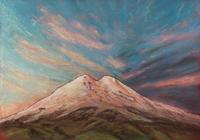
Elbrus summer sunset
Alina Danilova
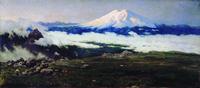
Sat-Mount (Mount Elbrus)
Mykola Yaroshenko
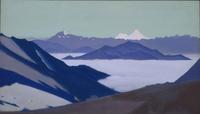
Fog in the mountains. Himalayas.
Nicholas Roerich
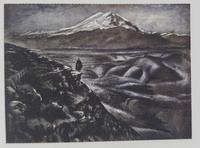
Elbrus
Oleg Holosiy
Voskevaz Aragats Etude
Petros Malayan
Ridge of Everest
Nicholas Roerich
Mount Thule, Bylot Island
Lawren Harris
Mont Blanc
Felix Vallotton
View of Jelar La
Nicholas Roerich
Himalayas
Nicholas Roerich
Rakaposhi Mountain
Alexandre Jacovleff
Landscape
Oleg Holosiy
Karakoram
Nicholas Roerich
Kashmir
Nicholas Roerich