
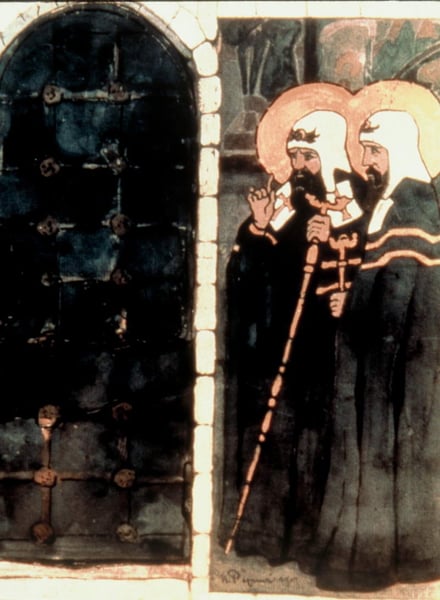
Expert analysis of Nicholas Roerich’s Foreign lords
Style: Art Nouveau (Modern) · Genre: genre painting
Expert Analysis of Nicholas Roerich’s Foreign Lords
Style Context (Art Nouveau / Modern)
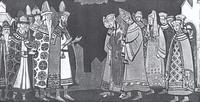
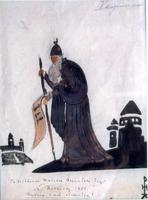
While Roerich is often categorized as a Symbolist and a mystic, Foreign Lords exemplifies his engagement with Art Nouveau’s decorative modernism. The painting’s sinuous lines, flattened spatial depth, and rhythmic, ornamental treatment of figures align with Art Nouveau’s rejection of rigid academic naturalism. Roerich adapts these stylistic traits to his own spiritual and historical vision: the elegant, elongated silhouettes of the “foreign lords” echo the organic curves typical of the style, while their richly patterned garments and the stylized landscape create a cohesive, almost tapestry-like surface. This work demonstrates how Art Nouveau could serve not only decorative or commercial ends but also convey a solemn, archaic grandeur—a signature of Roerich’s modernism.
Genre Painting as Cultural Commentary
As a genre painting, Foreign Lords transforms an ostensibly everyday scene—foreign dignitaries or merchants arriving in a setting that suggests ancient Russia or Central Asia—into a profound meditation on cross-cultural encounter. Roerich, deeply interested in the spiritual unity of East and West, uses the genre’s inherent narrative quality to stage a moment of silent significance. The lords are not merely figures of curiosity; their solemn, almost ritualistic bearing imbues the scene with the weight of historical and cosmic cycles. This elevates the painting beyond simple anecdotal depiction, making it a symbol of the meeting between worlds—a theme central to Roerich’s oeuvre and to the Art Nouveau fascination with the exotic and the timeless.
Significance
Foreign Lords is significant as a synthesis of Art Nouveau’s formal innovations with a genre subject that carries deep symbolic resonance. It shows how the movement could be harnessed for spiritual and historical narrative rather than mere ornamentation. Moreover, the painting anticipates Roerich’s later, more overtly metaphysical works, while grounding its mysticism in the concrete visual language of modernism. By filtering the “foreign” through an Art Nouveau lens—graceful, stylized, and symbolically charged—Roerich creates an image that is both a document of its time and a bridge to the transcendent.
Museum / Gallery
Visually similar
20 works with related composition and palette
Intercession of the Theotokos
Nicholas Roerich
Kneeling warriors (Study of murals for the chapel in Pskov)
Nicholas Roerich
Kneeling warriors (Study of murals for the chapel in Pskov)
Nicholas Roerich
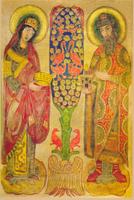
Glad visitors
Nicholas Roerich
Saint Alipiy the Iconographer
Viktor Vasnetsov
Beatus of Facundus
Facundus
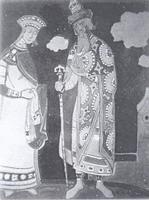
Snow Maiden and Berendey
Nicholas Roerich
L'Evangéliste Jean
Facundus
Yaroslav is glad for Kyiv
Nicholas Roerich
The fire of Babylon and the mourning of the kings and merchants
Ende
Arrival of Prince Michael Glanda Kambila to Russia, Veliky Novgorod
Nicholas Roerich
Icon The Descent of the Holy Spirit
Petro Kholodny (Elder)
Les âmes des martyrs persécutés. Autel mozarabe en T. Apoc. VI
Facundus
L'Evangéliste Marc
Facundus
The scene with the two large groups of figures in costumes
Nicholas Roerich
Kondor Béla, Kékszakállu Herceg
Kondor Béla
Le Christ se penche vers Jean. Jean envoie le Livre aux Sept Eglises d'Asie. Apoc. I
Facundus
Crown of the World
Nicholas Roerich
La Jérusalem nouvelle. Apoc. XXI
Facundus
Stargazer
Nicholas Roerich