Analisi esperta di Forest di Nicholas Roerich
Stile: Art Nouveau (Modern) · Genere: sketch and study
Expert Analysis: "Forest" by Nicholas Roerich
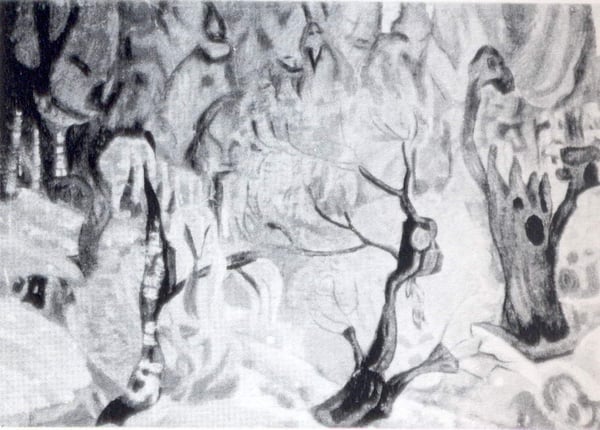
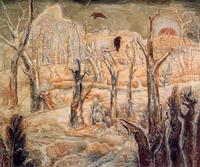
As an Art Nouveau (Modern) sketch and study, Nicholas Roerich’s Forest captures a pivotal intersection of decorative fluidity and spiritual symbolism that defines the artist’s early twentieth‑century practice. While the work is a preparatory study—suggesting an emphasis on line, composition, and atmospheric effect rather than finished detail—its significance lies in how it translates the core principles of Art Nouveau into a vision of nature as a living, mystical entity.
Stylistic and Period Significance
Roerich’s Forest exemplifies the Art Nouveau fascination with organic, curvilinear forms. The sketch likely employs the sinuous, flowing lines characteristic of the style, transforming tree trunks, branches, and foliage into a rhythmic, almost calligraphic pattern. This approach aligns with the movement’s goal of dissolving the boundary between natural and artificial, where every line pulses with a decorative yet deeply symbolic energy. As a study, it reveals Roerich’s process: distilling the forest into its essential, expressive shapes—a hallmark of the Modern impulse to prioritize subjective experience over literal representation.
Within Roerich’s Oeuvre
For Roerich, nature was never merely a backdrop; it was a conduit for spiritual and cosmic forces. In Forest, the sketch format allows him to capture the raw, untamed energy of the woods, emphasizing verticality and enclosure as a metaphor for initiation or sacred space. This aligns with his later, more mystical works (e.g., his Himalayan series) but here, the Art Nouveau vocabulary—twisting roots, arching boughs, dappled light—grounds the transcendent in the immediate, tactile world. The study’s unfinished quality heightens its sense of immediacy, inviting viewers into the artist’s private dialogue with the landscape.
Art Historical Importance
Forest demonstrates how Roerich adapted the international Art Nouveau idiom to a distinctly Russian sensibility—one steeped in folkloric and ancient pagan motifs. The sketch’s economy of means (likely graphite, watercolor, or gouache on paper) reveals the backbone of his mature style: a synthesis of decorative grace and monumental gravity. It stands as a testament to the sketch and study genre’s role in modernist practice—not as a mere precursor, but as a finished work in its own right, capturing the moment of inspiration where style and soul become one.
Visivamente simili
20 opere con composizione e palette affini
Forest
Nicholas Roerich
Autumn in the Park
Abraham Manievich
Winter in the dead wood
Albert Bloch
Untitled Landscape, Bellport (No.224)
Arthur Pinajian
Motives of the Russian landscape
Aleksey Savrasov
In the Woods
Paul Cezanne
Maaliskuu
Pekka Halonen
Bajka zimowa
Ferdynand Ruszczyc
Orpheus
Martiros Sarian
Untitled
Ligia Macovei
Orange Earth, Yellow Trees
Karl Schrag
Landscape
Andre Masson
Blossoming mountains
Martiros Sarian
The landscape behind
Alfred Freddy Krupa
A Fire in the Sky or the Black Cottage
Alfred Freddy Krupa
Untitled
Sohrab Sepehri
Woods in the Snow
Gustave Courbet
Landscape with Trees
Pierre-Auguste Renoir
The Park at Carrières-Saint-Denis
Georges Braque
A Row of Bare Trees
Vincent van Gogh