Analisi esperta di Fortress di Nicholas Roerich
Stile: Art Nouveau (Modern) · Genere: landscape
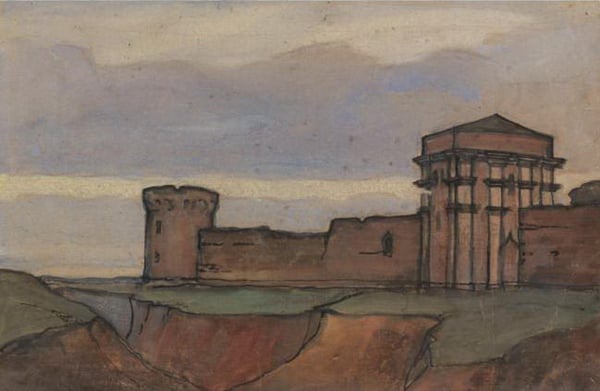
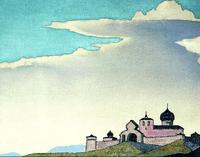
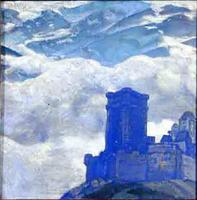
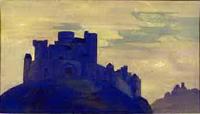
Nicholas Roerich’s "Fortress" is a compelling synthesis of Art Nouveau’s decorative sensibility and the genre of landscape, yet it transcends mere ornamentation to become a symbolic meditation on spiritual fortitude. Created during a period when Roerich was deeply engaged with esoteric philosophy and archaic Slavic heritage, the work belongs to his series of “fortress” paintings that evoke ancient, mythic strongholds rather than literal medieval castles.
Significance within Art Nouveau (Modern):
- Roerich subverts Art Nouveau’s typical urban or botanical motifs by applying its sinuous, flowing linework to a primordial, craggy landscape. The fortress walls seem to grow organically from the rock, echoing the whiplash curves of Hector Guimard or the intertwining forms of Alphonse Mucha, but here they are weathered and timeless, not decorative.
- The palette – muted blues, ochres, and deep earthy tones – creates a mystical twilight atmosphere that aligns with the Symbolist undercurrent of late Art Nouveau, where landscape becomes a vehicle for inner vision rather than topographical record.
Genre of Landscape:
- Roerich treats the landscape not as backdrop but as protagonist. The fortress is half-ruined, half-living, its jagged silhouette merging with the sky and mountain ridges, suggesting the resilience of the human spirit against cosmic forces. This is a psychological landscape, typical of Roerich’s “silent” compositions – devoid of human figures, yet charged with ancestral presence.
- The horizon is high, compressing the space and emphasizing the fortress’s vertical thrust, while the layered, almost geometric forms prefigure the synthetic simplicity of early Modernism.
Why It Matters:
“Fortress” is significant because it bridges the decorative elegance of Art Nouveau with the metaphysical concerns of early 20th-century modernism. It refuses to be merely a pretty scene; instead, it uses style to evoke a lost, sacred geography – a fortress as both shelter and threshold, embodying Roerich’s lifelong belief in the unity of art, nature, and spiritual evolution. In doing so, it elevates the landscape genre from observation to revelation.
Visivamente simili
20 opere con composizione e palette affini
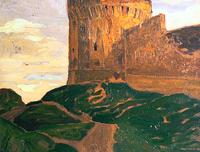
Smolensk. Tower.
Nicholas Roerich
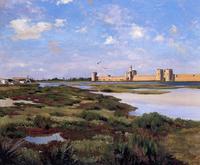
Landscape of Aigues-Mortes
Frederic Bazille
Castle Nègrepeliss
Jean-Honore Fragonard
Aqueducts in the Roman Campagna
Camille Corot
View of Vasto
Gabriele Smargiassi
Summer Evening (Caernarvon Castle)
Richard Wilson
Roman Countryside Rocky Valley with a Herd of Pigs
Camille Corot
Novgorod. Kukui Tower.
Pyotr Konchalovsky
View of the Tiber and Castel St. Angelo
Jacques-Louis David
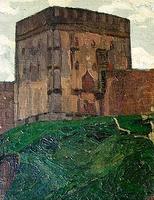
Smolensk. Tower.
Nicholas Roerich
Study to "Wanderer of the light city"
Nicholas Roerich
Sugdayya
Konstantin Bogaevsky
Novgorod Kremlin (Detinets)
Pyotr Konchalovsky
The ramparts of Aigues-Mortes
Alexandre-Gabriel Decamps
Mall of Aigues-Mortes
Frederic Bazille
Along the coast
Ioannis Altamouras
The Ruined Tower of Heidelberg Castle
Carl Blechen
Castle
Nicholas Roerich
Castle. The Doomed City.
Nicholas Roerich
Northumberland: Norham Castle
William Leighton Leitch