
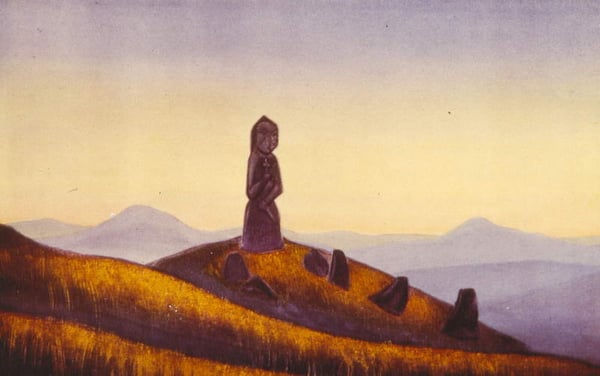
Analisi esperta di Guardian of desert di Nicholas Roerich
Stile: Symbolism · Genere: landscape
Expert Analysis: "Guardian of Desert" by Nicholas Roerich
Nicolas Roerich’s “Guardian of Desert” exemplifies the core tenets of Symbolist landscape painting, where the natural world becomes a vessel for metaphysical and spiritual meaning. Within the Symbolist movement—which prioritized inner vision, mysticism, and emotion over literal representation—Roerich stands apart for his synthesis of Eastern philosophies, Theosophical ideals, and a deeply personal iconography.
What Makes This Work Significant:
-
Spiritual Watchfulness in a Barren Realm
The title itself signals the central Symbolist preoccupation: the “Guardian” is not merely a human figure but an archetypal sentinel—perhaps a saint, an ascetic, or a personification of the desert’s own protective spirit. In Roerich’s cosmology, deserts are not empty wastelands but liminal spaces of meditation and revelation. The guardian figure, likely rendered as a small, stark silhouette against vast dunes, embodies vigilance, solitude, and the threshold between the material and the divine. -
Symbolist Use of Color and Atmosphere
Roerich relies on a restricted, luminous palette—typically deep blues, ambers, and ochres—to evoke a timeless, almost preternatural light. The desert’s heat and silence become tangible, while the horizon dissolves into a shimmering haze. This atmospheric technique, characteristic of Roerich’s Himalayan and Central Asian scenes, transforms the landscape into a symbolic stage where the physical world mirrors the soul’s journey. -
Integration of East and West
Unlike many Western Symbolists who drew from Christian or Classical myth, Roerich infuses his works with Buddhist, Hindu, and shamanic motifs. The “Guardian” may allude to the Mahatmas (enlightened masters) of Theosophical lore or to the Dharmapala (protectors of the teachings) in Tibetan Buddhism. This cross-cultural symbolism was revolutionary in early 20th-century art, positioning Roerich as a pioneer of spiritual globalism. -
Narrative of Protection and Resilience
In the Symbolist tradition, a landscape is never just a setting—it is a state of consciousness. Here, the desert’s harshness becomes a test of faith, and the guardian stands as an emblem of unwavering purity. Roerich’s work resonates with contemporary audiences seeking art that transcends mere representation, offering instead a meditative encounter with the sublime.
Conclusion:
“Guardian of Desert” is significant because it encapsulates Roerich’s unique contribution to Symbolism: a landscape that is simultaneously a psychological portrait, a spiritual allegory, and a visual meditation. It challenges viewers to see the desert not as absence, but as presence—a sacred space guarded by an eternal, silent watchfulness.
Visivamente simili
20 opere con composizione e palette affini
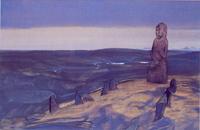
Keeper of Cuple
Nicholas Roerich
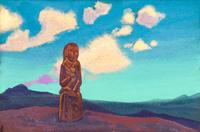
The holder of the cup. Mongolia.
Nicholas Roerich
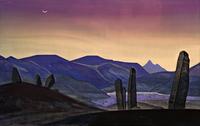
Black Gobi
Nicholas Roerich
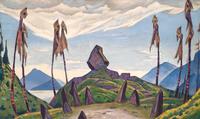
Study of scene decoration for "The Rite of Spring"
Nicholas Roerich
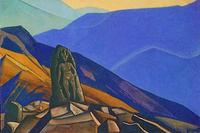
Abode of the spirit
Nicholas Roerich
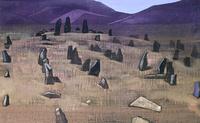
Doring, Tibetian menhirs.
Nicholas Roerich
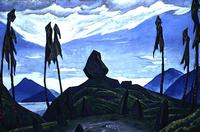
The Rite of Spring
Nicholas Roerich
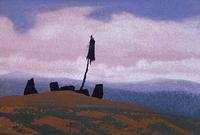
Khan's grave
Nicholas Roerich
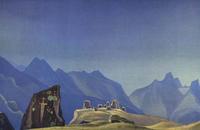
Sword of Gesar
Nicholas Roerich
Dusk (Bands and End-Points)
Jo Baer
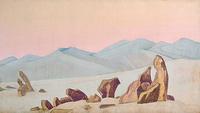
Kereksury
Nicholas Roerich
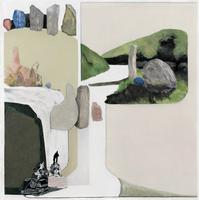
Royal Families (Curves, Points and Little Ones)
Jo Baer
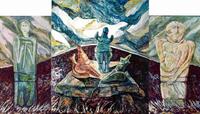
Eternity
Eleonora Brigalda Barbas
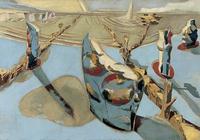
Circle of the Monoliths
Paul Nash
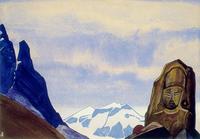
Maitreya
Nicholas Roerich
Figures in landscape
Henryk Streng
Pillars of salt
Natalia Goncharova
Foggy Beach
Maria Bozoky
Becheș' Cross (Transylvanian Landscape)
Stefan Caltia

Beda the Preacher
Nicholas Roerich