Análisis experto de Himalayas de Nicholas Roerich
Estilo: Symbolism · Género: landscape
Expert Analysis: "Himalayas" by Nicholas Roerich
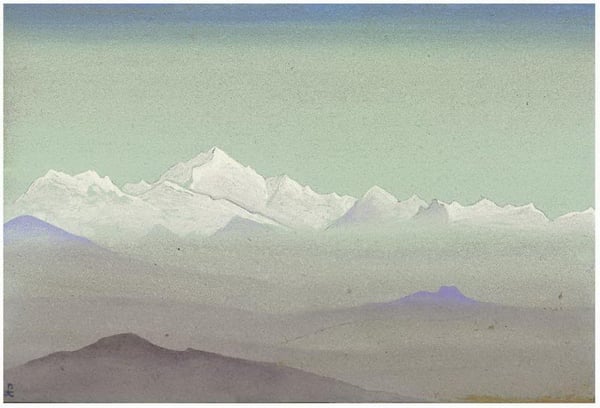
Nicholas Roerich’s "Himalayas" stands as a quintessential example of Symbolist landscape painting, where the natural world is not merely depicted but transformed into a vessel for spiritual and metaphysical meaning. Within the Symbolist movement—which prioritized inner vision, emotion, and the mystical over literal representation—Roerich’s treatment of the Himalayan range elevates this work from a topographical study to a profound meditation on the sublime.
Significance within Style and Period:
Roerich’s use of bold, often unmodulated color areas and a simplified, almost archaic composition reflects Symbolism’s rejection of Impressionist naturalism. In "Himalayas," the peaks are rendered in clear, luminous tones—typically deep blues, purples, and ethereal whites—that seem to radiate an inner light. This technique aligns with the Symbolist goal of making visible the invisible, suggesting the mountains are not just geological forms but thresholds between the earthly and the divine. The composition often emphasizes verticality and a stark, silent majesty, creating a sense of awe that recalls the Romantic sublime but is tempered by a distinctly Eastern spiritual quietude—a hallmark of Roerich’s personal synthesis of Russian Symbolism and Buddhist/Tibetan philosophy.
Genre and Thematic Resonance:
As a landscape, "Himalayas" transcends its genre by functioning as an icon of sacred geography. Roerich, who traveled extensively in Central Asia and was deeply influenced by the idea of Shambhala, imbues the scene with a sense of pilgrimage and inner pilgrimage. The absence of human figures or overt narrative forces the viewer to confront the scene directly, mirroring the Symbolist emphasis on subjective experience. The painting’s significance lies in its ability to make the viewer feel the “silence of the heights,” a concept Roerich cultivated through his theosophical interests.
Why This Work Matters:
"Himalayas" is significant because it encapsulates Roerich’s unique contribution to Symbolism: using landscape as a language of the soul. It exemplifies how Symbolist artists looked beyond European traditions to global spiritualities—here, Himalayan Buddhism—to forge a new, universal aesthetic. The work’s enduring power is its capacity to evoke a transcendent stillness, inviting contemplation rather than visual pleasure. In the context of early 20th-century art, it stands as a bold assertion that landscape could be a vehicle for the sacred, a idea that continues to influence spiritual and visionary art.
Género
Estilo
Visualmente similares
20 obras con composición y paleta relacionadas

Himalayas
Nicholas Roerich

Himalayas
Nicholas Roerich
Sunset
Nicholas Roerich

Kangchenjunga
Nicholas Roerich

Himalayas
Nicholas Roerich

Himalayas
Nicholas Roerich

Himalayas [Terrestrial and celestial]
Nicholas Roerich

Himalayas (study). Holy Himalayas
Nicholas Roerich

Himalayas
Nicholas Roerich

Himalayas. Guru Guri Dhar.
Nicholas Roerich

Himalayas
Nicholas Roerich

Himalayas
Nicholas Roerich

Himalayas. Moon mountains.
Nicholas Roerich

Himalayas
Nicholas Roerich

Sacred Himalayas
Nicholas Roerich

Himalayas
Nicholas Roerich

Himalayas. Sunrise.
Nicholas Roerich

Himalayas. Sunny contour of the mountains.
Nicholas Roerich

Himalayas
Nicholas Roerich

Mount of five treasures (Two worlds)
Nicholas Roerich