
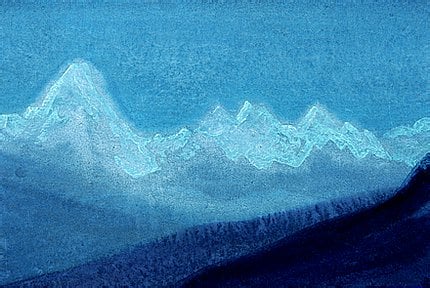
Himalayas
Expertenanalyse zu Nicholas Roerichs Himalayas
Stil: Symbolism · Genre: landscape
Analysis of "Himalayas" by Nicholas Roerich
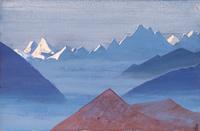
Nicholas Roerich’s "Himalayas" is a landmark work within the Symbolist movement and the landscape genre, distinguished by its profound fusion of spiritual vision and natural majesty. Painted during Roerich’s intense engagement with Eastern philosophy and the remote mountain ranges of Central Asia, the work transcends mere topography to become a meditation on the sublime and the eternal.
Key Features & Stylistic Significance
-
Symbolist Palette and Atmosphere: Roerich employs a distilled, almost spectral palette—dominated by icy blues, gossamer whites, and deep purple shadows—to evoke the Himalayas not as a physical place but as a threshold between the earthly and the divine. The luminous, flat planes of color and the lack of fine detail align with Symbolism’s rejection of naturalistic representation in favor of emotional and metaphysical resonance.
-
Composition as Spiritual Allegory: The towering peaks are rendered as layered, triangular forms rising from a dark foreground, suggesting a journey from the mundane into the transcendental. This vertical ascent is a recurrent Symbolist motif, representing the soul’s aspiration toward enlightenment. Roerich’s peaks seem to glow from within, as if illuminated by an inner light—a hallmark of his belief in the sacred animism of the mountain landscape.
-
Cultural and Philosophical Context: Roerich’s Himalayan paintings were produced during his Central Asian expeditions (1923–1928), where he sought to document and synthesize the spiritual traditions of the East. "Himalayas" functions as a visual counterpart to his writings on Shambhala and the unity of all religions. The painting’s stark, simplified forms and ethereal glow reflect Theosophical ideas of an underlying cosmic harmony—making it a key work in the Symbolist project of painting ideas rather than objects.
Significance Within Symbolism and Landscape Art
Within the Symbolist canon, "Himalayas" stands out for its unique blend of plein-air observation and visionary symbolism. While many Symbolists turned to mythological or dreamlike scenes, Roerich grounded his mysticism in actual landscapes, elevating the natural world into a site of spiritual revelation. This approach influenced later painters of the mystical landscape tradition and helped redefine the genre as a vehicle for philosophical inquiry. The work’s serene, timeless quality also anticipates aspects of Abstract Expressionism’s interest in the sublime.
In sum, "Himalayas" is significant not only as a masterpiece of Roerich’s oeuvre but as a quintessential Symbolist landscape—one that uses the raw power of nature to explore the borders of consciousness, spirituality, and art.
Visuell ähnlich
20 Werke mit ähnlicher Komposition und Farbpalette
Himalayas
Nicholas Roerich
Himalayas
Nicholas Roerich
Himalayas
Nicholas Roerich

Himalayas
Nicholas Roerich

Himalayas
Nicholas Roerich

Himalayas
Nicholas Roerich
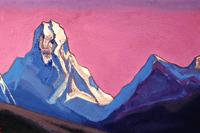
The giant
Nicholas Roerich
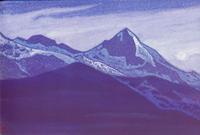
Himalayas
Nicholas Roerich

Himalayas. Sunny contour of the mountains.
Nicholas Roerich

Himalayas
Nicholas Roerich

Nanda Devi
Nicholas Roerich

Himalayas. Pink peaks.
Nicholas Roerich
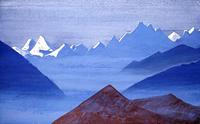
Himalayas. Guru Guri Dhar.
Nicholas Roerich
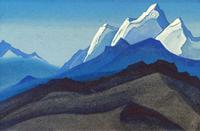
Himalayas
Nicholas Roerich

Himalayan Snows
Nicholas Roerich

Himalayas
Nicholas Roerich

Himalayas. Varicoloured snows.
Nicholas Roerich
Sunset
Nicholas Roerich

Himalayas
Nicholas Roerich

Himalayas
Nicholas Roerich