
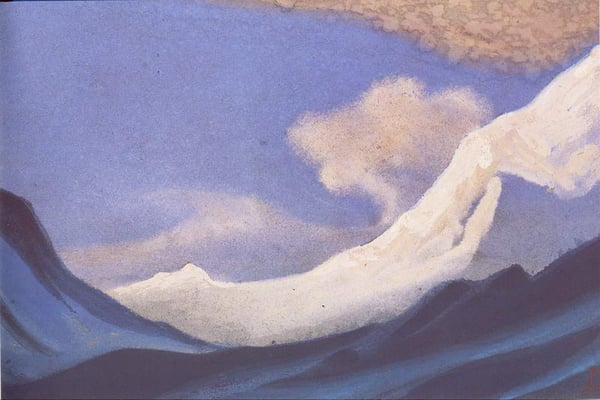
Himalayas
Expert analysis of Nicholas Roerich’s Himalayas
Style: Symbolism · Genre: landscape
Expert Analysis of "Himalayas" by Nicholas Roerich
Nicholas Roerich’s "Himalayas" is a masterful example of Symbolist landscape painting, where the natural world becomes a conduit for spiritual and metaphysical meaning. Within the Symbolist movement—which rejected literal representation in favor of evoking ideas, emotions, and mystical truths—Roerich’s depiction of the Himalayan range stands out for its ability to transform a specific geological subject into a universal icon of transcendence.
Significance within the Symbolist Style:
Roerich treats the Himalayas not as a mere topographic record but as a sacred, otherworldly vision. The mountain peaks, rendered in luminous, often monochromatic blues and purples, seem to glow from within, suggesting an inner, divine radiance. This use of color and simplified, almost ethereal forms moves beyond realism to evoke a sense of the sublime and the infinite—a core Symbolist aim. The composition emphasizes verticality and ascension, guiding the viewer’s eye upward as if toward a higher realm of consciousness. Such a landscape becomes a metaphor for spiritual striving, meditation, and the union of earth and heaven.
Genre and Period Context:
As a landscape, "Himalayas" exemplifies Symbolism’s redefinition of the genre. For Roerich, the Himalayas were not just a subject of personal fascination but a symbol of humanity’s quest for enlightenment—a theme especially resonant in the early 20th century, when Symbolism was at its height and artists sought alternatives to materialist art. Roerich’s work is significant for merging Eastern spiritual traditions (he lived and traveled extensively in India and Tibet) with European Symbolist aesthetics, creating a cross-cultural icon that remains a touchstone for mystical landscape painting.
What Makes It Stand Out:
The painting’s power lies in its quiet, meditative stillness. Unlike more dramatic Romantic landscapes, Roerich’s "Himalayas" achieves transcendence through restraint and clarity. The absence of human figures or narrative action forces the viewer to confront the mountain as a presence—silent, eternal, and charged with symbolic meaning. This work is a quintessential example of how Symbolism used landscape to express the invisible, making the spiritual visible through color, light, and composition.
Museum / Gallery
Visually similar
20 works with related composition and palette

Kampa Dzong. Pink Peak.
Nicholas Roerich
Himalayas
Nicholas Roerich
Himalayas
Nicholas Roerich
Pink glacier as flower
Nicholas Roerich
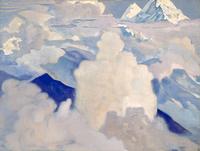
White and Celestial
Nicholas Roerich
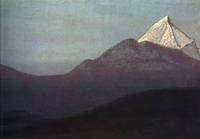
Himalayas. Pink peak.
Nicholas Roerich
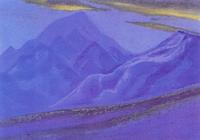
Ladakh. Golden clouds over blue mountains.
Nicholas Roerich
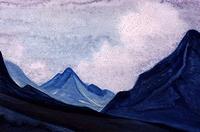
Himalayas
Nicholas Roerich
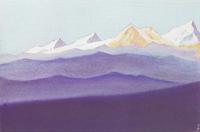
Himalayas
Nicholas Roerich
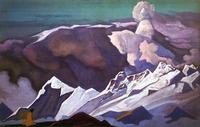
Kalki Avatar
Nicholas Roerich

Himalayas. Moon mountains.
Nicholas Roerich
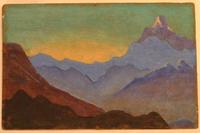
Sunrise in Himalayas
Nicholas Roerich

Himalayas
Nicholas Roerich

Kangchenjunga
Nicholas Roerich

Warrior of Light
Nicholas Roerich

The glory of Himalayas
Nicholas Roerich

Ladakh
Nicholas Roerich

Tibet
Nicholas Roerich

Himalayas
Nicholas Roerich

Himalayas
Nicholas Roerich