
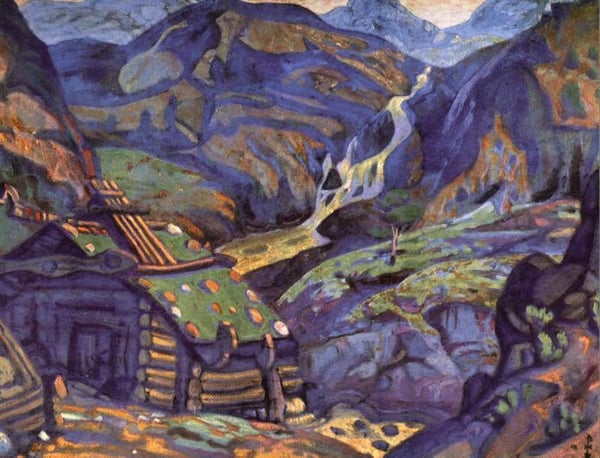
Analisi esperta di Mill in the mountains di Nicholas Roerich
Stile: Art Nouveau (Modern), Symbolism · Genere: design
Expert Analysis of "Mill in the mountains" by Nicholas Roerich
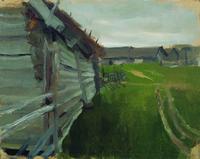
Nicholas Roerich’s Mill in the mountains is a striking example of the artist’s ability to merge the decorative elegance of Art Nouveau with the profound spiritual undercurrents of Symbolism. Though categorized as a design work—likely a stage set or decorative panel—the composition transcends mere ornamentation, becoming a visual meditation on the relationship between human industry and the sublime landscape.
Significance within Art Nouveau and Symbolism
Within the Art Nouveau movement, Roerich’s work stands out for its disciplined, rhythmic lines and flattened, stylized forms. The mill—often a humble agrarian structure—is here transformed into an almost heraldic emblem, its wheel and roof echoing the organic curves and vertical thrusts prized by Art Nouveau designers. Yet Roerich subverts the usual decorative frivolity of the style by infusing the scene with Symbolist gravity. Mountains are not merely backgrounds but sacred presences, representing higher spiritual planes—a key theme in Roerich’s philosophy. The mill, grinding grain into flour, becomes a symbol of transformation and earthly labor against the eternal, unchanging peaks.
Genre as Design: A Synthesis of Function and Mysticism
As a design piece, Mill in the mountains likely served a practical purpose—perhaps for a theater production (Roerich was famed for his ballet and opera sets) or as a decorative mural. Its significance lies in how Roerich elevates utilitarian imagery into a contemplative icon. The interplay of horizontal mill elements with vertical mountain silhouettes creates a balanced, almost heraldic composition that would read clearly from a distance, fulfilling the design brief while retaining symbolic depth. This ability to fuse the decorative ethos of Art Nouveau with the metaphysical aspirations of Symbolism marks Roerich as a unique bridge between these two movements. The work exemplifies his lifelong quest to harmonize human creativity with nature’s grandeur, making it a quiet but powerful statement on the sacredness of everyday toil in the shadow of the eternal.
Visivamente simili
20 opere con composizione e palette affini
Mill in the mountains
Nicholas Roerich
Autumn at Strålsjøen
Harriet Backer
Langebrata
Theodor Severin Kittelsen
Summer Day
Konstantin Makovsky
Kem
Konstantin Korovin
Almlandschaft Im Ötztal
Albin Egger-Lienz
Solveig's Song (Hut in the forest)
Nicholas Roerich
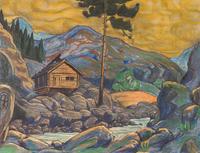
Hut in the mountains
Nicholas Roerich
Lime Kiln, Baie-Saint-Paul
Clarence Gagnon
Farvel Da Mor
Theodor Severin Kittelsen
Mill on the mountain stream
Andreas Achenbach
Winter in Lapland
Konstantin Korovin
Landscape with cottages
Konstantin Korovin
Spring
Mikhail Nesterov
Khvalynsk
Kuzma Petrov-Vodkin
Moon Rising at the Staffelalp
Ernst Ludwig Kirchner
Hills
Nicholas Roerich
Winter
Igor Grabar
Sage
Nicholas Roerich
Landscape in the Kostroma region
Boris Kustodiev