
Nicholas Roerich sanatçısının Mother of the World eseri hakkında uzman analizi
Tarz: Symbolism · Tür: religious painting
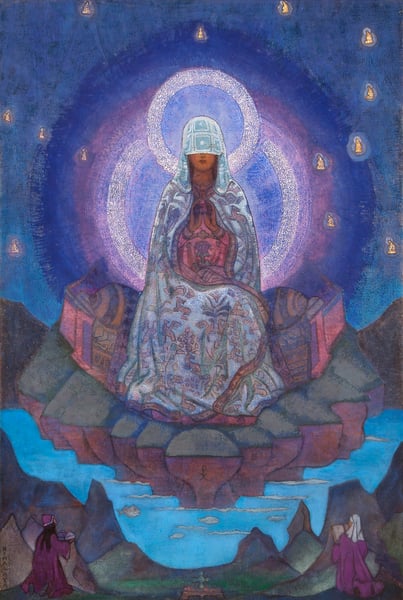
As an expert art historian, I will analyze "Mother of the World" by Nicholas Roerich based solely on its known attributes: Style: Symbolism and Genre: religious painting. The significance of this work lies in how it synthesizes Symbolist ideals with a transcendent, universal religious vision.
Expert Analysis
1. Symbolist Language and the Evocation of the Ineffable Within the Symbolist movement, Roerich’s "Mother of the World" is a quintessential example of art that prioritizes inner vision over external reality. The work does not aim to depict a literal scene but rather to act as a conduit for spiritual experience. Roerich employs the classic Symbolist strategy of using color, form, and composition as signs of a higher, non-material truth. The absence of naturalistic detail forces the viewer into a contemplative state, making the painting a meditative object. Its significance within Symbolism lies in its complete rejection of narrative illustration in favor of pure, evocative presence—the "Mother" is not a character in a story but an archetypal force made manifest through color and light.
2. A Universal Religious Icon, Not a Sectarian Image As a religious painting, "Mother of the World" is significant for its radical departure from traditional Western iconography (e.g., the Madonna and Child). Roerich, deeply influenced by Eastern philosophy and Theosophy, creates a religious image that is deliberately non-denominational and universal. The figure of the Mother is not a specific saint or deity but a personification of the cosmic feminine principle—the nurturing, protecting, and generative aspect of the divine. This aligns with Symbolism’s fascination with esoteric and syncretic spirituality. The painting’s power comes from its ability to function as a sacred object for anyone, regardless of creed, by tapping into a primal, cross-cultural archetype. It reimagines religious painting as a tool for spiritual awakening rather than doctrinal instruction.
3. Significance in Roerich’s Oeuvre and the Symbolist Canon Roerich’s "Mother of the World" is a masterwork of his mature period, where he perfected a style of luminous, otherworldly landscapes and monumental, simplified figures. The painting is significant for its bold, almost musical use of color—typically deep blues, whites, and golds—which create an atmosphere of infinite space and silent majesty. The work exemplifies how Symbolism could break free from the melancholy and decadence often associated with the movement (as in Moreau or Redon) and instead embrace a tone of radiant, optimistic mysticism. By fusing religious genre with Symbolist abstraction, Roerich created an image that is both ancient in its spiritual resonance and modern in its formal simplicity—a true icon of early 20th-century spiritual art.
Museum / Gallery
Görsel olarak benzer
İlişkili kompozisyon ve renk paletine sahip 20 eser
Mother of the World
Nicholas Roerich
Queen of Heaven over River of Life
Nicholas Roerich
Madonna in Gloria
Antoniazzo Romano
Madonna Col Bambino Tra I Santi Sebastiano, Lazzaro, Maddalena E Marta
Lo Scheggia
Mother of God
Viktor Vasnetsov
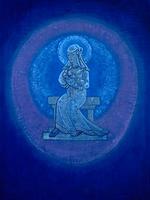
Mother of Turfan
Nicholas Roerich
Adoration
Tsuguharu Foujita
Madonna and Child with Two Votaries
Paolo Veneziano
Daybreak
George Stefanescu
Roses of Heart. Princess Olga.
Nicholas Roerich
Madonna and Child
Paul Guiragossian
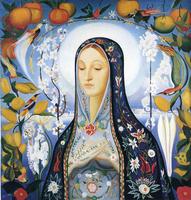
The Virgin
Joseph Stella
La Vierge et l'enfant
Tsuguharu Foujita
Madonna Col Bambino Fra Otto Angeli
Pietro Lorenzetti
Bright star
Orthodox Icons
Madonna and Child
Luca di Tommé
The First Study for the Madonna of Port Lligat
Salvador Dali
Madonna
Viktor Vasnetsov
Madonna and Child Enthroned (Maesta)
Cimabue
Theotokos of Chernobyl
Orthodox Icons