
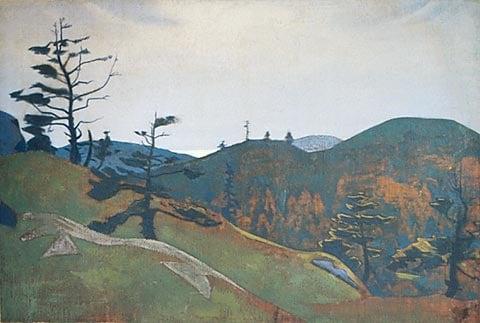
Analisi esperta di Pir Panjal di Nicholas Roerich
Stile: Symbolism · Genere: landscape
Expert Analysis of "Pir Panjal" by Nicholas Roerich
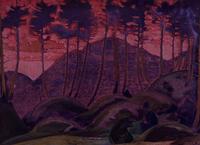
As a landmark within the Symbolist movement, Nicholas Roerich’s Pir Panjal transcends mere topographic representation to become a meditative vision of the sacred in nature. The work is significant for how it embodies Symbolism’s core ambition—to evoke inner spiritual states through external landscape, rather than to document a specific place. Roerich, a master of the Himalayan series, employs the Pir Panjal mountain range not as a geological subject but as a threshold between the earthly and the cosmic.
The painting’s significance lies in its deliberate simplification: sweeping, unbroken forms of peaks and valleys, rendered in a restrained, almost mineral palette, strip the scene of anecdotal detail. This compression of space and color aligns with Symbolist principles that prioritize mood and idea over literal accuracy. The viewer is invited into a silent, crystalline world where light seems to emanate from within the mountains themselves—a hallmark of Roerich’s spiritual symbolism. The composition, often a stark horizon line dividing earth and sky, emphasizes the sublime immensity of the natural world, reducing the human presence to a mere witness.
Within the Symbolist period (c. 1885–1910s and beyond), Roerich’s Pir Panjal stands out for its fusion of Eastern mystical philosophy with Western Symbolist form. While many Symbolists (like Moreau or Redon) drew on myth and fantasy, Roerich turned to the actual geography of Central Asia as a living symbol of spiritual ascent. The painting thus becomes a bridge: a realistic mountain range transformed into an archetype of transcendence. Its enduring significance is that it makes the invisible—the numinous quality of the Himalayan landscape—visually palpable, securing Roerich’s place as a unique voice who used landscape to speak of the soul.
Museum / Gallery
Visivamente simili
20 opere con composizione e palette affini
Monhegan (Fairytale)
Nicholas Roerich
Sketch for The Jack Pine
Tom Thomson
The Elements
J. E. H. MacDonald
Yellow Sky
Elmer Bischoff
After Sunset, Georgian Bay
J. E. H. MacDonald
Language of forest
Nicholas Roerich
The West Wind
Tom Thomson
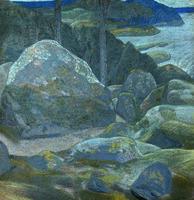
Hoary Finland
Nicholas Roerich
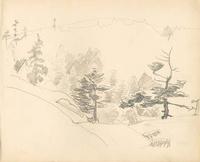
Monhegan (study)
Nicholas Roerich
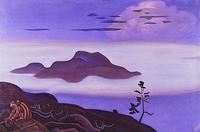
Treasure
Nicholas Roerich
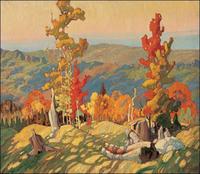
Autumn in the Northland
Franklin Carmichael
Karelia
Nicholas Roerich
Pine Island, Georgian Bay
Tom Thomson
Sketch for The West Wind
Tom Thomson
The Mediterranean Coast
Henri-Edmond Cross
Forest Landscape
Lajos Tihanyi
Stormy Weather, Georgian Bay
Frederick Varley
The Jack Pine
Tom Thomson
Monhegan (study)
Nicholas Roerich
The Language of the Forest
Nicholas Roerich