
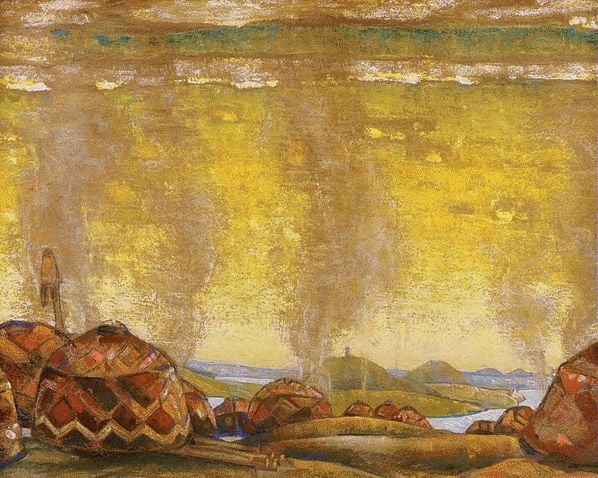
Expertenanalyse zu Nicholas Roerichs Polovtsian camp
Stil: Art Nouveau (Modern) · Genre: design
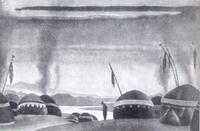
Expert Analysis: "Polovtsian Camp" by Nicholas Roerich
Artist: Nicholas Roerich
Style: Art Nouveau (Modern)
Genre: Design
Artwork: Polovtsian Camp
Context and Significance
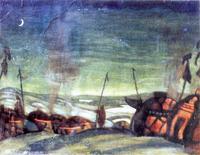
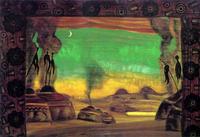
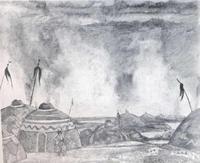
Nicholas Roerich was a pivotal figure in early 20th-century Russian art, celebrated for his integration of spiritual symbolism, folkloric motifs, and theatrical design. Polovtsian Camp is not a standalone painting but a stage and costume design—most likely conceived for the famous Polovtsian Dances from Alexander Borodin’s opera Prince Igor. This places the work squarely within the Art Nouveau movement’s ambition to synthesize fine arts with applied arts, particularly through theatrical production.
Art Nouveau Characteristics in the Work
Art Nouveau (or Modern in Russian contexts) prized organic, flowing lines, exoticism, and a decorative, total-art approach. Roerich’s design embodies these principles:
- Ornamental dynamism: The composition uses sinuous curves and rhythmic patterns—echoing the movement of dancers and the wind-swept steppe—to create a sense of living, breathing space. Tents, banners, and costumes likely feature stylized, interlaced motifs drawn from Central Asian and ancient Slavic sources.
- Synthesis of arts: As a design, this work bridges architecture, costume, and painting. Roerich’s palette—earthy ochres, deep blues, and vivid reds—enhances the exotic, ritualistic atmosphere while remaining cohesive with the Art Nouveau love for symbolic color.
- Inspiration from nature and folklore: The “Polovtsian” theme (referring to the nomadic Cumans) allowed Roerich to explore a romanticized, primal naturalism. His tents mimic organic forms (hills, shells) and his patterns echo embroidery and weaponry, marrying the man-made with the wild.
Why It Is Significant
- Avant-garde theatrical design: Roerich was among the first to treat stage design as a high art form, influencing the Ballets Russes and later modernist theater. Polovtsian Camp demonstrates how Art Nouveau could transform performance space into a total visual experience.
- Cultural fusion: The work reflects the Russian Silver Age fascination with the East. Roerich’s depiction is not merely decorative but spiritually charged—he saw the steppe as a crucible of ancient wisdom, anticipating his later Himalaya-inspired works.
- Art Nouveau’s global reach: While most Art Nouveau focused on urban luxury (Parisian metro, glassware), Roerich’s design expands the movement into epic, archaeological fantasy, proving its versatility beyond the domestic sphere.
Final Assessment
Polovtsian Camp stands as a masterful example of Art Nouveau design applied to narrative spectacle. It encapsulates the movement’s hallmark traits—organic line, decorative richness, and interdisciplinary ambition—while infusing them with Roerich’s unique mysticism and historical depth. The work remains a landmark in the history of stagecraft, demonstrating how art can transport audiences into a vivid, stylized world of nomadic splendor.
Visuell ähnlich
20 Werke mit ähnlicher Komposition und Farbpalette
Kyrgyz tent on the Chu River
Vasily Vereshchagin
Yurtas
Nicholas Roerich
Yurtas
Nicholas Roerich
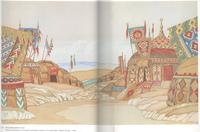
Sketch for the opera "Prince Igor" by Alexander Borodin
Ivan Bilibin
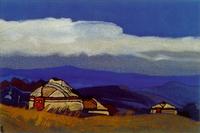
Mongoliya (Olun Sume)
Nicholas Roerich
Moonlit night in mountains
Taras Shevchenko
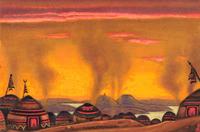
Polovtsian camp
Nicholas Roerich
Polovtsian camp
Nicholas Roerich
Polovtsian camp
Nicholas Roerich
The interior of the yurt of rich Kirghiz
Vasily Vereshchagin
Polovtsian camp
Nicholas Roerich
Polovtsian camp
Nicholas Roerich
Reflections in a River
Walter Battiss

Mongolia. Yurtas.
Nicholas Roerich
Mongolian yurtas
Nicholas Roerich
Mongolian lama
Nicholas Roerich
Halt
Francisc Sirato
A rich Kyrgyz hunter with a falcon
Vasily Vereshchagin
A village of the Hidatsa tribe at Knife River
George Catlin

The Grand Tetons, Wyoming
Albert Bierstadt