
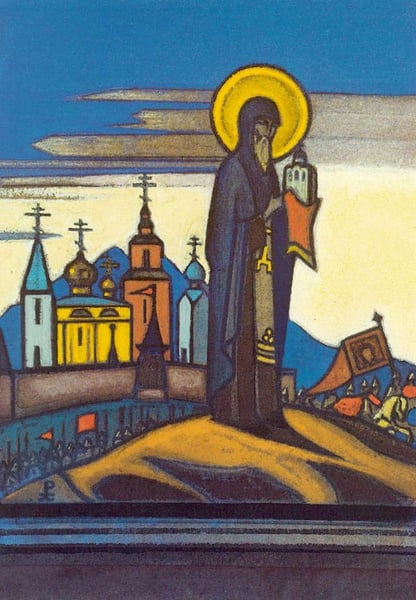
Analisi esperta di Saint Sergius di Nicholas Roerich
Stile: Art Nouveau (Modern), Symbolism · Genere: religious painting
As an expert art historian, I will analyze Nicholas Roerich's "Saint Sergius" through the lens of its stated styles—Art Nouveau (Modern) and Symbolism—and its religious genre, focusing on its significance within these contexts.
Analysis of "Saint Sergius" by Nicholas Roerich
Roerich’s Saint Sergius is a pivotal work that bridges the decorative elegance of Art Nouveau with the metaphysical depth of Symbolism, while reanimating the Russian iconographic tradition for a modern audience. Its significance lies in how it synthesizes these three currents into a unified spiritual statement.
Within Art Nouveau (Modern): The painting embodies Art Nouveau’s linear rhythm and flattened, ornamental space. Roerich likely employs sweeping, sinuous contours—characteristic of the style—to delineate the saint’s figure, his halo, and the surrounding landscape, creating a harmonious, quasi-tapestry effect. The use of a limited, jewel-toned palette (perhaps deep blues, golds, and earthy reds) is typical of Art Nouveau’s preference for decorative harmony over naturalistic detail. This modern stylization pushes the image away from literal representation and toward an iconic, symbolic plane.
Within Symbolism: Roerich, a leading figure in Russian Symbolism, uses the saint not as a historical portrait but as an archetype of spiritual asceticism and divine connection. The landscape—likely a stark, mountainous or rocky terrain—functions as a symbol of the soul’s journey and the rugged path of holiness. The emphasis on hieratic stillness and the play of inner light (rather than external illumination) are hallmarks of Symbolist painting, where the visible world is a veil for deeper, transcendental truths. Saint Sergius himself becomes a symbol of Russia’s sacred destiny, a theme Roerich explored persistently.
Within Religious Painting: The work revives the medieval Russian icon tradition, but filtered through a modern sensibility. Instead of the flat gold ground of a traditional icon, Roerich creates an atmospheric, spiritualized space. The saint’s elongated proportions, the solemnity of his pose, and the concentrated focus on his face recall the devotional intensity of icons, yet the composition remains distinctly of its time—a fusion of ancient piety and contemporary aesthetic innovation.
Significance in Period/Style: Saint Sergius is significant because it demonstrates how Art Nouveau’s formal elegance could serve a deeply spiritual, nationalistic purpose. Roerich transforms the decorative tendencies of the style from mere ornament into a vehicle for mystical experience. By doing so, he elevates religious painting beyond church tradition, placing it at the center of the Symbolist quest for universal meaning. The work stands as a testament to the Russian Silver Age’s ambition to reunite art, faith, and a visionary sense of history.
Visivamente simili
20 opere con composizione e palette affini
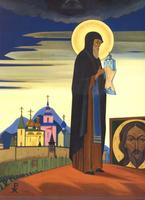
Sergius of Radonezh
Nicholas Roerich
Saint Alipiy the Iconographer
Viktor Vasnetsov
St. Prince Vladimir
Ivan Bilibin
Procopius the Righteous
Nicholas Roerich
St.Olga of Kyiv
Nicholas Roerich
Prince Andrew Bogolyubskii
Ivan Bilibin
St. Prince Alexander Nevsky
Orthodox Icons
St. Prince Vladimir
Ivan Bilibin
Zvenigorod
Nicholas Roerich
Monks Anthony and Theodosius of the Caves
Orthodox Icons
Saint Nicholas
Nicholas Roerich
St Kyrill
Jerzy Nowosielski
Snow Maiden
Nicholas Roerich
St. Prince Vladimir
Ivan Bilibin
Saint Catherine of Alexandria
Orthodox Icons
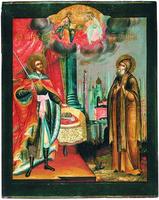
St. Prince Alexander Nevsky And Daniel of Moscow
Orthodox Icons
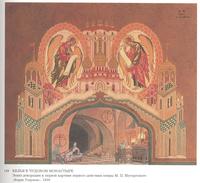
Sketch for the opera "Boris Godunov" by Modest Mussorgsky
Ivan Bilibin
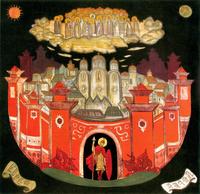
The saints have gone - leave Gleb as keeper
Nicholas Roerich
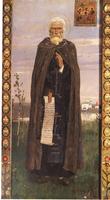
St. Sergius of Radonezh
Viktor Vasnetsov
Sadko
Ivan Bilibin