
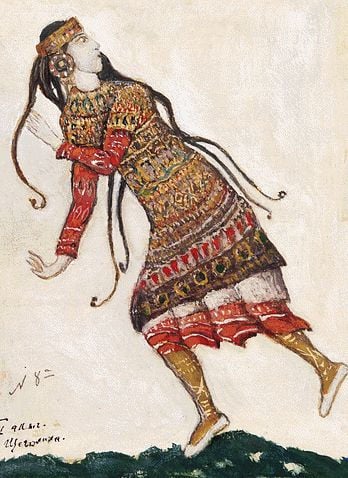
Nicholas Roerich の Sketch of costumes for "The Rite of Spring" の専門的な分析
スタイル:Art Nouveau (Modern) · ジャンル:design
As an expert art historian, I would analyze "Sketch of costumes for 'The Rite of Spring'" by Nicholas Roerich as follows:
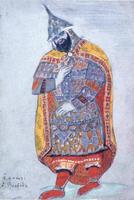
This work is a significant bridge between the decorative elegance of Art Nouveau and the raw, primal energy that defined the early 20th-century avant-garde. Created for the legendary 1913 Ballets Russes production of Stravinsky's "The Rite of Spring," Roerich's costume sketch transcends mere theatrical design to become a key artifact of modernism.
Significance within Art Nouveau (Modern): While Art Nouveau is often characterized by its sinuous, organic lines and natural forms, Roerich’s sketch reorients that vocabulary toward a more austere, archaic sensibility. Instead of the typical floral or feminine motifs, he draws inspiration from ancient Slavic and Eurasian folk traditions. The costumes are stylized with bold, flat color fields and geometricized shapes—such as the draped tunic and conical headpiece—that evoke prehistoric ritual. This aligns with the broader Modernist turn away from ornament toward essential form, yet it retains Art Nouveau’s commitment to a unified, total work of art (Gesamtkunstwerk). The sketch’s fusion of decorative patterning (the striped and bordered textiles) with a stark, almost monumental silhouette prefigures the shift toward the geometric abstraction of Art Deco and later modernist design.
Significance within the Genre of Design: Roerich’s design is not merely illustrative; it is a functional architectural blueprint for the dancer’s body. The costumes were integral to the ballet’s revolutionary choreography by Nijinsky, where dancers moved with stiff, turned-in feet and jerky, angular gestures. Roerich’s heavy, layered fabrics and restrictive shapes directly influenced the movement vocabulary, making the sketch a collaborative document of performance design. Conceptually, it reimagines the human figure as a carrier of symbolic, tribal identity, stripping away individualism in favor of collective ritual power. This approach was groundbreaking for its time, as it rejected the ethereal, romantic ballet costume in favor of a grounded, earthbound aesthetic.
Cultural and Historical Significance: Roerich’s work for "The Rite of Spring" is pivotal because it visually articulates the ballet’s central theme: the violent, ecstatic sacrifice of a chosen one to appease the forces of nature. The costume sketch captures this tension between the refined, decorative surface (Art Nouveau’s love of line and pattern) and the brutal, primitive subject matter (a celebration of pagan Russia). By channeling ancient folk iconography through a modern lens, Roerich helped define a new visual language for the 20th century—one that could express both the elegance of the modern stage and the deep, ancestral fears and joys of the human psyche. This sketch remains a testament to how design can transcend its functional role to become a profound artistic statement about modernity’s relationship with its own past.
視覚的に類似
構図やパレットが近い作品 20 件
Shchegolikha
Nicholas Roerich
Girl
Nicholas Roerich
Girl
Nicholas Roerich
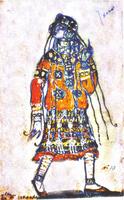
Shchegolikha
Nicholas Roerich
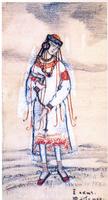
Girl
Nicholas Roerich
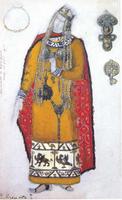
Isolde
Nicholas Roerich
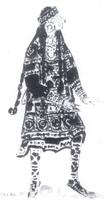
Shchegolikha
Nicholas Roerich
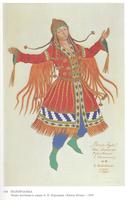
Costume design for the Opera "Prince Igor" by Alexander Borodin
Ivan Bilibin
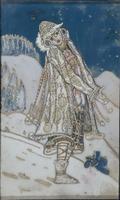
Snow Maiden
Nicholas Roerich
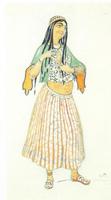
Captive
Nicholas Roerich
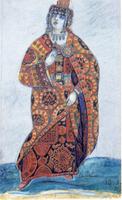
Yaroslavna
Nicholas Roerich
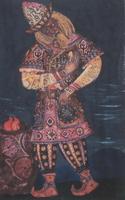
Oze
Nicholas Roerich
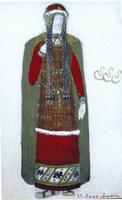
The lady of entourage
Nicholas Roerich
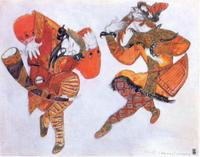
Clowns Skula and Yeroshka
Nicholas Roerich
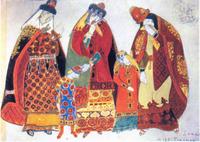
Boyarynia and children
Nicholas Roerich
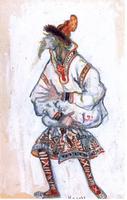
People (Old man)
Nicholas Roerich
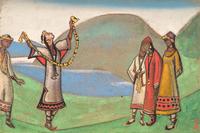
Girls
Nicholas Roerich
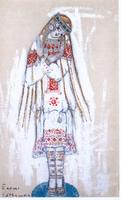
Girl
Nicholas Roerich
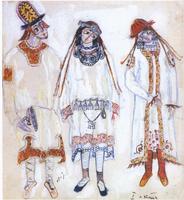
Three personages
Nicholas Roerich
Voivode
Nicholas Roerich