
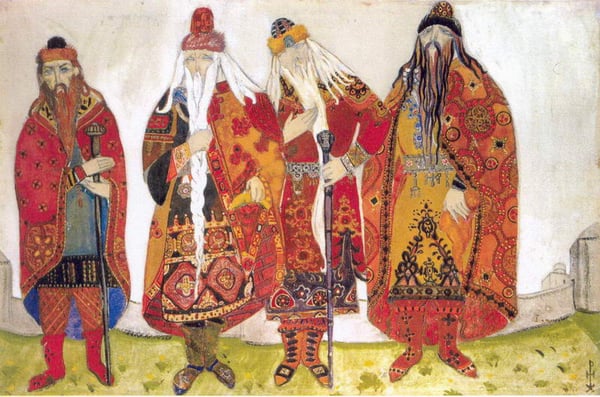
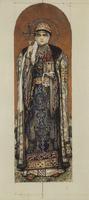
Sketches of costumes for "Prince Igor"
Expertenanalyse zu Nicholas Roerichs Sketches of costumes for "Prince Igor"
Stil: Art Nouveau (Modern) · Genre: design
Expert Analysis: “Sketches of costumes for ‘Prince Igor’” by Nicholas Roerich
Nicholas Roerich’s costume sketches for Borodin’s opera Prince Igor represent a pivotal intersection of Art Nouveau aesthetics and historicist stage design, marking their significance within the broader Modern movement. Though the genre is “design,” these works transcend mere illustration—they are integral to Roerich’s visionary synthesis of ancient Slavic heritage and the decorative, symbolist language of Art Nouveau.
Key aspects of significance:
-
Art Nouveau’s adaptation to narrative theatre. Roerich abandons the sinuous floral motifs typical of Art Nouveau in favor of bold, architectonic lines and flat, jewel-toned color fields. The costumes evoke the monumental, hieratic quality of medieval Russian frescoes and embroidered folk textiles, yet the stylized silhouettes—sharply angular shoulders, elongated sleeves, and geometric headdresses—mirror Art Nouveau’s obsession with the “total work of art” (Gesamtkunstwerk). The sketches are not historical recreations but interpretations that give the epic opera a modern, mystical aura.
-
Role in the Ballets Russes context. Although Prince Igor is an opera, Roerich’s designs align with the revolutionary stagecraft of Diaghilev’s Ballets Russes, which frequently employed avant-garde artists. These costume sketches anticipate Roerich’s later, more famous work for the ballet The Rite of Spring (1913). The bold simplification of form—reducing armor, fur, and brocade into rhythmic, almost abstract patterns—demonstrates how Art Nouveau principles were being redirected toward a primal, pre-modern Russia, anticipating the shift into Symbolism and early Modernism.
-
Ethnographic authenticity fused with decorative abstraction. Roerich was a dedicated archaeologist and scholar of ancient Slavic and Scythian cultures. In these sketches, the costumes retain identifiable elements (e.g., pointed helmets, caftans, mantle clasps) but are flattened into decorative motifs that emphasize line over volume. This approach makes the designs both historically evocative and visually modern—a hallmark of Art Nouveau’s desire to merge past and present, nature and culture, into a cohesive ornamental system.
-
Influence on theatrical design. Roerich’s Prince Igor costumes helped liberate stage costume from naturalism. By treating fabric as a canvas for symbolic, two-dimensional design, he influenced later modernist designers like Léon Bakst and Aleksandr Golovin. The sketches’ enduring significance lies in their proof that even a functional genre (costume design) can achieve the lofty, transcendent goals of Art Nouveau: to transform every element of daily and ritual life into art.
In sum, these works are significant because they channel the spiritual nationalism and decorative vitality of Art Nouveau into a historically rooted, operatic context, creating a blueprint for modernist stagecraft while preserving the epic grandeur of Borodin’s masterpiece.
Visuell ähnlich
20 Werke mit ähnlicher Komposition und Farbpalette
Boyarynia and children
Nicholas Roerich
Illustration for the fairytale "Go there do not know where, bring it I do not know what"
Ivan Bilibin
Illustration for Alexander Pushkin's 'Fairytale of the Tsar Saltan'
Ivan Bilibin
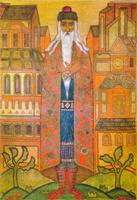
Householder
Nicholas Roerich
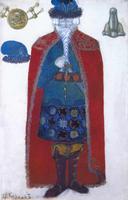
King Mark
Nicholas Roerich
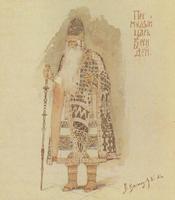
Wise King Berendey
Viktor Vasnetsov
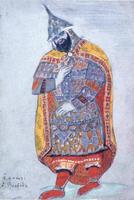
Voivode
Nicholas Roerich
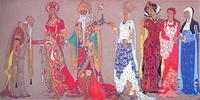
Sketches of costumes for "Princess Maleine"
Nicholas Roerich
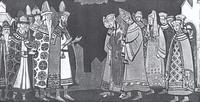
The scene with the two large groups of figures in costumes
Nicholas Roerich
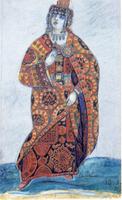
Yaroslavna
Nicholas Roerich
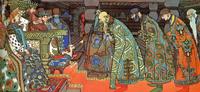
Merchants. Illustration for Alexander Pushkin's 'Fairytale of the Tsar Saltan'
Ivan Bilibin
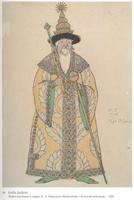
Sketch for the Opera, The Golden Cockerel, by Nikolai Rimsky-Korsakov
Ivan Bilibin
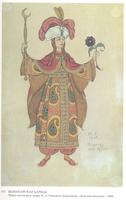
Costume design for the Opera, The Golden Cockerel, by Nikolai Rimsky-Korsakov
Ivan Bilibin
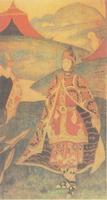
Russian warrior
Nicholas Roerich
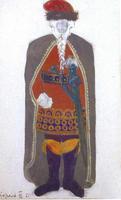
King Mark
Nicholas Roerich
Snow Maiden and Berendey
Nicholas Roerich
Courtier
Nicholas Roerich
From Nereditskaya Church
Fyodor Solntsev
Prince Golitsyn and the boyars
Konstantin Korovin
Princess Olga
Viktor Vasnetsov