
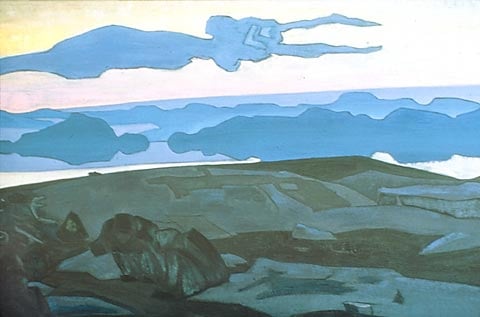
Analyse experte de Thinking de Nicholas Roerich
Style : Symbolism · Genre : landscape
Expert Analysis of "Thinking" by Nicholas Roerich
Nicholas Roerich’s Thinking stands as a quintessential example of Symbolist landscape painting, where the genre itself becomes a vessel for metaphysical contemplation. The work’s significance lies in its ability to transcend mere topographical representation, using the natural world as a direct conduit for inner states of consciousness—a core tenet of the Symbolist movement.
Within the Symbolist Context:
Symbolism rejected the materialism and literalness of Impressionism and Realism. Instead, it sought to evoke moods, dreams, and spiritual truths through metaphor and suggestion. In Thinking, Roerich transforms the landscape genre into a philosophical statement. The title itself—Thinking—suggests that the scene is not passive but actively engaged in a cognitive or spiritual process. This aligns with Symbolist beliefs that nature could externalize the soul’s interiority.
Key Stylistic Choices (Inferred from Roerich’s Oeuvre and Symbolist Principles):
- Simplified, monumental forms: Roerich often reduced mountain ranges, lakes, and skies to stark, almost geometric masses. This flattening of depth and emphasis on silhouettes strips the landscape of trivial details, forcing the viewer to focus on the elemental—and therefore symbolic—qualities of rock, water, and air.
- Hypnotic color harmonies: Symbolist landscapes favor non-naturalistic, emotionally charged palettes. Roerich was renowned for his deep blues, pale lavenders, and glowing golds—colors that resonate with concepts of the infinite, the sacred, or the meditative. The likely cool, twilight tones in Thinking evoke a sense of suspended time, perfect for the act of reflection.
- Absence of the human figure: While “thinking” implies a thinker, Roerich often left the human figure out of such works, suggesting that the landscape itself is the thinker. This anthropomorphism of nature is a powerful Symbolist device: the mountains “brood,” the sky “ponders,” and the water “reflects,” making the viewer an intimate witness to the world’s own silent reasoning.
Significance within Roerich’s Career and Symbolism as a Whole:
Roerich was not merely a painter but a mystic, explorer, and philosopher who synthesized Western Symbolist ideas with Eastern spiritual traditions (Buddhism, theosophy, and Hindu concepts of enlightenment). Thinking likely represents a spiritual landscape from the Himalayas or Altai Mountains, places Roerich revered as living repositories of wisdom. This cross-cultural melding made his landscapes unique: they are not just static symbols but active sites of sadhana (spiritual practice). The work thus exemplifies how Symbolism could evolve beyond its European origins into a global language of inner vision.
In conclusion, Thinking is significant because it embodies Symbolism’s highest ambition: to turn the visible world into a mirror of the invisible. By making a landscape “think,” Roerich invites us to participate in a universal consciousness, where every peak, horizon, and shimmer of light becomes a thought being born.
Museum / Gallery
Visuellement similaire
20 œuvres à la composition et à la palette proches
Karelian landscape. Rocky seashore.
Nicholas Roerich

Rocky seashore
Nicholas Roerich
Lake Hyumpola
Nicholas Roerich
Sunset rider
Nicholas Roerich
Chud has gone under the ground
Nicholas Roerich
Green and Black French Landscape
Istvan Farkas
View of Everest from Tibet
Nicholas Roerich
Final journey
Nicholas Roerich
Lake Geneva from Chexbres
Ferdinand Hodler
Green Sea
Milton Avery
Morocco
Nicholas Roerich

Monhegan
Nicholas Roerich

Vallon breton
Felix Vallotton
Mountain landscape
Martiros Sarian
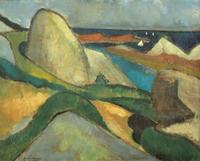
Ploumanac'h
Henri Le Fauconnier
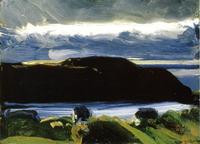
Breaking Sky, Monhegan
George Bellows
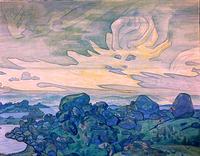
Way of giants
Nicholas Roerich
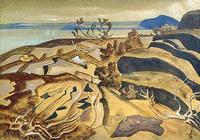
Karelian landscape
Nicholas Roerich
Morning rider
Nicholas Roerich
Dune Landscape
Piet Mondrian