
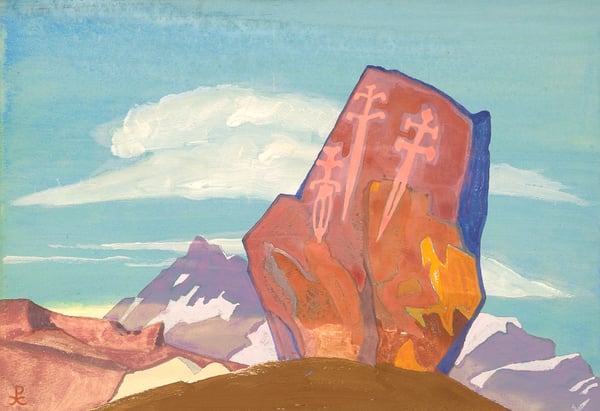
Three swords
Nicholas Roerich sanatçısının Three swords eseri hakkında uzman analizi
Tarz: Symbolism · Tür: mythological painting
Expert Analysis of "Three Swords" by Nicholas Roerich
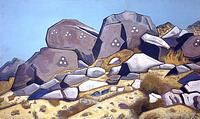
Nicholas Roerich’s Three Swords is a compelling example of Symbolist mythological painting, a genre in which Roerich excelled by fusing esoteric philosophy, ancient folklore, and a deeply spiritual sense of color and form. As a leading figure of the Russian Symbolist movement, Roerich sought not to depict observable reality but to evoke hidden truths and archetypal forces. In this work, the three swords function as a potent symbol, likely drawing from Norse, Slavic, or Eastern mythologies where multiples of three often signify fate, cosmic order, or the tripartite nature of existence (e.g., past–present–future, mind–body–spirit, or the three Norns of destiny in Norse myth).
The painting’s significance lies in how Roerich uses the swords as more than mere weapons. In Symbolist art, objects are charged with metaphysical meaning: here, the blades may represent guardianship, sacrifice, or the threefold path to enlightenment. Roerich’s characteristic palette—often rich, glowing blues, purples, and golds—would have imbued the scene with an otherworldly, almost ritualistic atmosphere. The composition likely centers the swords in a stark landscape (a hallmark of Roerich’s Himalayan and Siberian-inspired vistas), emphasizing their role as timeless symbols rather than narrative props.
What makes Three Swords particularly significant within Roerich’s oeuvre and Symbolism as a whole is its integration of the artist’s lifelong preoccupations: the unity of all religions, the power of ancient myths, and the search for spiritual evolution. By choosing a mythological context, Roerich elevates the swords from mere objects to keys that unlock a hidden, universal knowledge. This work stands as a testament to Symbolism’s goal—to express the inexpressible through evocative imagery—and to Roerich’s unique ability to blend Eastern mysticism, Russian folklore, and theosophical ideas into a single, resonant image.
Görsel olarak benzer
İlişkili kompozisyon ve renk paletine sahip 20 eser
Sword of King Gesar
Nicholas Roerich

Rocks of Ladakh
Nicholas Roerich
Lahaul rocks (Signs of Gesar)
Nicholas Roerich
Three swords. Paintings on the stone.
Nicholas Roerich

Rocks of Ladakh
Nicholas Roerich
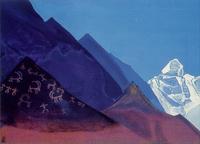
Rocks of Ladakh
Nicholas Roerich
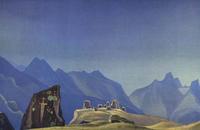
Sword of Gesar
Nicholas Roerich
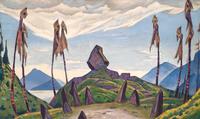
Study of scene decoration for "The Rite of Spring"
Nicholas Roerich

Path to Kailas
Nicholas Roerich

Maitreya
Nicholas Roerich
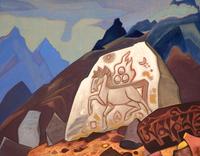
White Stone (Sign of Cintamani or Horse of happiness)
Nicholas Roerich
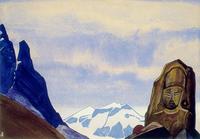
Maitreya
Nicholas Roerich
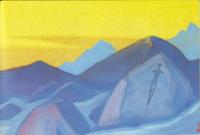
Boundary of sword (study)
Nicholas Roerich
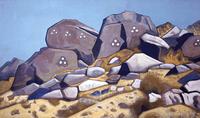
Rocks of Mongolia
Nicholas Roerich
Shara-Muren
Nicholas Roerich
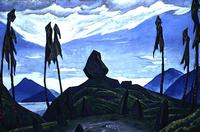
The Rite of Spring
Nicholas Roerich
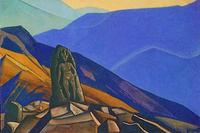
Abode of the spirit
Nicholas Roerich
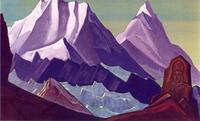
Maitreya
Nicholas Roerich
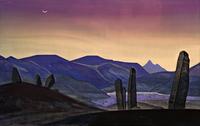
Black Gobi
Nicholas Roerich
Tibet
Nicholas Roerich