Analisi esperta di Trans-Himalayas, view from Saga-Dzong di Nicholas Roerich
Stile: Symbolism · Genere: landscape
Expert Analysis: "Trans-Himalayas, view from Saga-Dzong" by Nicholas Roerich
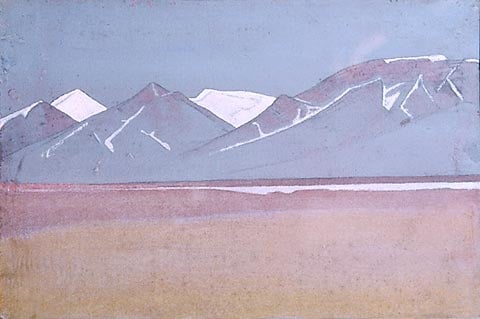
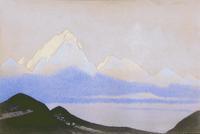
Nicholas Roerich’s Trans-Himalayas, view from Saga-Dzong (c. 1930s–1940s) stands as a quintessential example of the artist’s mature Symbolist landscape vision, merging precise topography with transcendent spirituality. Painted during his prolonged expedition through Central Asia, this work is significant for its ability to transform a factual geographical viewpoint into a metaphysical statement—a hallmark of Roerich’s unique contribution to Symbolism.
Stylistic and Symbolist Significance
Roerich, deeply influenced by Theosophy and Eastern philosophy, uses the landscape not merely as a record of place but as a vehicle for inner revelation. The composition, viewed from the Saga-Dzong monastery in Tibet, presents layered mountain ranges that recede into a luminous, almost ethereal horizon. This layered depth echoes the Symbolist preoccupation with the unseen—each ridge becomes a step toward enlightenment, a visual metaphor for spiritual ascent. The palette is restrained yet potent: cool blues and purples in the shadows, warm rose and gold on the peaks, and a stark white sky. These colors are not naturalistic but emotive, evoking the “pure light” of the Himalayas as a symbol of cosmic consciousness.
Genre and Innovation within Landscape
While classified as a landscape, Roerich’s work transcends the genre’s typical focus on earthly beauty. Here, the landscape is a living icon. The absence of human figures emphasizes the sublime scale, yet the view from Saga-Dzong (a sacred site) implies a contemplative presence—the viewer stands in the monk’s or pilgrim’s place, invited into silence and meditation. This aligns with Symbolism’s goal to depict the ideal over the real. Roerich’s precise rendering of snow and rock, combined with his simplified, almost monumental forms, creates a hybrid style: realistic enough to be identifiable, yet stylized to evoke eternity.
What Makes It Significant
- Cultural Synthesis: Roerich bridges Eastern and Western Symbolist traditions. The painting reflects his belief in the spiritual unity of Asia, a key theme of his Roerich Pact and Banner of Peace.
- Technical Mastery: His use of tempera (or casein) on canvas yields a matte, gem-like surface, enhancing the otherworldly glow. The thin, deliberate brushwork mimics the texture of ancient Tibetan thangkas, reinforcing the sacred aura.
- Influence on Spiritual Art: This work exemplifies Roerich’s role in 20th-century Symbolism, where landscape became a medium for exploring the “New Era” of human consciousness. It inspired later visionary artists and remains a touchstone for the integration of art, spirituality, and environmental reverence.
In sum, Trans-Himalayas, view from Saga-Dzong is not just a view of mountains—it is a portal. Roerich transforms the physical Himalayas into a symbol of the soul’s journey, making this painting a landmark in Symbolist landscape and a testament to art’s power to articulate the ineffable.
Visivamente simili
20 opere con composizione e palette affini
Trans-Himalayas
Nicholas Roerich
Kurumkan
Mikhail Olennikov
Himalayan Landscape
Nicholas Roerich
Himalayas. Golden clouds on a purple sky.
Nicholas Roerich
Himalayas
Nicholas Roerich
Mountain chain at sunset
Cuno Amiet
Sunset near Shekar
Nicholas Roerich
Himalayas
Nicholas Roerich
Everest
Nicholas Roerich
Trans-Himalayas
Nicholas Roerich
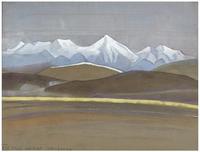
Ak-Tagh. Lenin's Mountain.
Nicholas Roerich
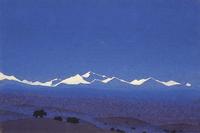
Nan Shan, Tibetan Frontier
Nicholas Roerich
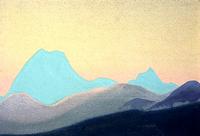
Ladakh
Nicholas Roerich
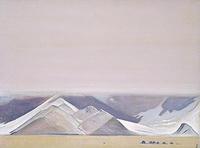
Bogdo-Ul. Hurricane.
Nicholas Roerich
Lake Vular
Nicholas Roerich
Place of Mahatma's camp. District Kuku-Nor.
Nicholas Roerich
Kangchenjunga
Nicholas Roerich
Jyagong
Nicholas Roerich
Himalayas [Terrestrial and celestial]
Nicholas Roerich
Himalayas
Nicholas Roerich