
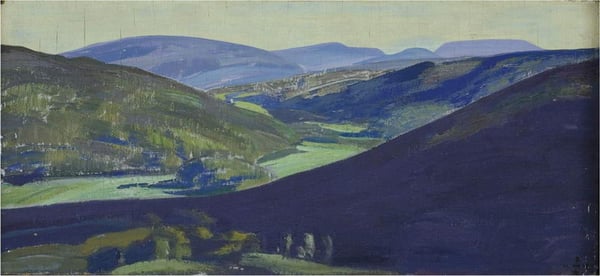
Analisi esperta di Tulola valley di Nicholas Roerich
Stile: Symbolism · Genere: landscape
Expert Analysis of "Tulola Valley" by Nicholas Roerich
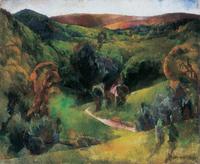
Nicolas Roerich’s Tulola Valley stands as a quintessential example of Symbolist landscape painting, where the natural world is transformed into a stage for spiritual and metaphysical inquiry. Working within the Symbolist style—a movement that rejected mere visual replication in favor of evoking inner truths and mystical resonances—Roerich elevates a simple valley into a meditative vision.
Significance within Symbolism and Roerich’s Oeuvre
Roerich’s landscapes are never topographical records; they are portals to a higher reality. In Tulola Valley, the compositional structure—likely featuring soaring mountain peaks, a placid valley floor, and a luminous sky—serves as a visual metaphor for the journey from the material to the divine. The mountain, a recurring motif for Roerich, symbolizes spiritual ascent and the eternal, while the valley often represents the earthly realm in transition.
The painting exemplifies the Symbolist interest in mood over mimesis. Roerich’s characteristic palette—deep blues, purples, golds, and whites—suggests a twilight or pre-dawn atmosphere, a liminal time charged with cosmic potential. This use of color is not descriptive but expressive, meant to induce a contemplative state in the viewer.
What Makes It Significant
- Spiritual Geography: Roerich was deeply influenced by Theosophy and Eastern philosophy. Tulola Valley likely depicts a real location in the Himalayas (where Roerich lived and traveled), but it is transformed into a sacred site, a “landscape of the soul.” This merging of actual topography with transcendent symbolism is a hallmark of his mature work.
- Cultural Synthesis: Roerich uniquely blended Russian Orthodox iconographic traditions with Buddhist and Hindu concepts of sacred landscape. The valley becomes a universal symbol of peace and spiritual aspiration, aligning with Symbolism’s goal of uniting art, religion, and philosophy.
- Technical Execution: Roerich’s simplified, almost abstract forms—smooth expanses of color, rhythmic outlines, and a lack of anecdotal detail—direct the eye toward pure essence. This reductionist approach anticipates later developments in abstract and mystical art, making Tulola Valley a bridge between late 19th-century Symbolism and 20th-century spiritual abstraction.
In summary, Tulola Valley is significant not as a faithful depiction of a place, but as a visionary landscape that encapsulates Roerich’s Symbolist mission: to use nature as a cipher for the invisible and to remind the viewer of the sublime harmony underlying all existence.
Visivamente simili
20 opere con composizione e palette affini
Tulola
Nicholas Roerich
Finnish landscape. Tulolansaari island.
Nicholas Roerich
Rocks & cliffs.
Nicholas Roerich
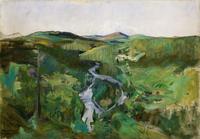
Landscape from Foldalen
Harriet Backer
Landscape with small town
Cesare Tallone
Pod Górami.
Czesław Jan Pyrgies
In the Foothills of the Carpathians
Adalbert Erdeli
Bistrița Valley
Dumitru Ghiatza
On Bistrița Valley
Dumitru Ghiatza
Near Jaca
Joaquín Sorolla

Over the Dniester River
Margit Selska

Mountain Landscape
Adalbert Erdeli
Neighborhoods Khvalynsk
Kuzma Petrov-Vodkin
Landscape
Lajos Tihanyi

Bluff
Edward Hopper
Landscape
Bertalan Por
Light Hill
Michael Kinsley

Valley in the Auvergne
Theodore Rousseau
Spring Hillside
Abbott Handerson Thayer
Landscape in Felsobanya
Vilmos Aba-Novak