
Expertenanalyse zu Nicholas Roerichs Yarilin calls
Stil: Symbolism · Genre: mythological painting
Expert Analysis of "Yarilin Calls" by Nicholas Roerich
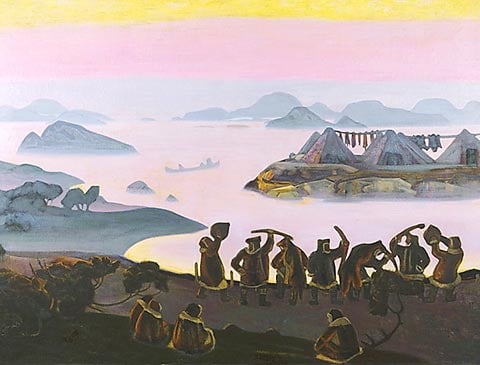
As a Symbolist mythological painting, Nicholas Roerich’s Yarilin Calls holds significance within the movement’s broader turn toward spiritual and archetypal subject matter. Roerich, a master of Symbolism, uses this work to invoke the primal, pantheistic energies of Slavic folklore—specifically the god Yarilo, a deity of spring, fertility, and the sun. The painting’s importance lies in how it distills Symbolism’s core ambition: to convey invisible, transcendent forces through vivid, often stark, visual metaphors.
Within the Symbolist period, artists sought to escape literal representation and instead evoke mood, myth, and inner truth. Yarilin Calls achieves this through a composition that likely emphasizes sweeping landscape, dramatic light, and a sense of ritualistic call—elements typical of Roerich’s style. The mythological genre allowed him to bridge ancient pagan beliefs with modern spiritual longing, making the work a key example of how Symbolism repurposed folk traditions to critique materialism and reconnect with cosmic rhythms.
Roerich’s significance here is twofold: he not only elevates Slavic mythology to a universal Symbolist language but also anticipates later mystical and environmental themes in art. Yarilin Calls stands as a testament to Symbolism’s power to transform local legend into a timeless meditation on humanity’s place within nature and the divine.
Visuell ähnlich
20 Werke mit ähnlicher Komposition und Farbpalette
Stone Age
Nicholas Roerich
Gypsy camp in the Puszta
Anton Romako
Camp Scene at Grand Portage
Eastman Johnson
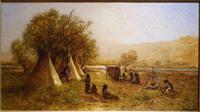
Cheyenne Encampment
Ralph Blakelock
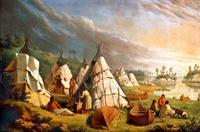
Native American encampment
Paul Kane
Western Montage
Charles M. Russell
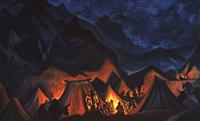
Whispers of desert
Nicholas Roerich
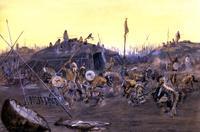
The Mandan Dance
Charles M. Russell
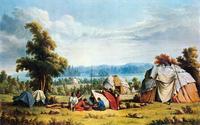
Ojibwe Indian Encampment Sault
Paul Kane
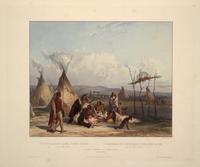
Funeral Scaffold of a Sioux Chief near Fort Pierre, plate 11 from Volume 2 of 'Travels in the Interior of North America'
Karl Bodmer
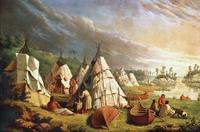
Native American Encampment Granger
Paul Kane
Crowns
Nicholas Roerich
The Piegans Preparing to Steal Horses from the Crows
Charles M. Russell
Lewis and Clark Meeting the Mandan Indians
Charles M. Russell
Encampment Among the Islands of Lake Huron Paul Kane
Paul Kane
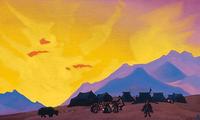
Tibetian camp
Nicholas Roerich
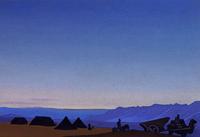
Caravan
Nicholas Roerich
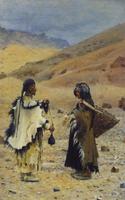
West Tibetans
Vasily Vereshchagin
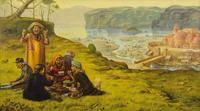
Lunch in the green
Otto Frello
8. Buying Land from the Indians
Francis Davis Millet