Analisi esperta di Alexander Serebryakov di Zinaida Serebriakova
Stile: Expressionism · Genere: portrait
Expert Analysis: "Alexander Serebryakov" by Zinaida Serebriakova
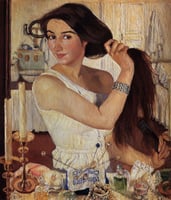
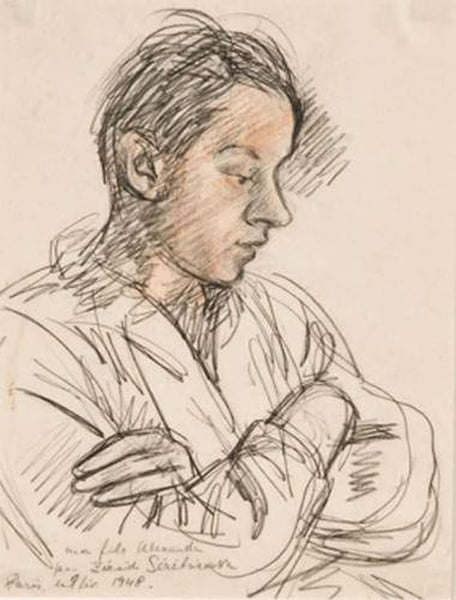
Zinaida Serebriakova’s “Alexander Serebryakov” is an Expressionist portrait that encapsulates the movement’s core aim: to convey inner emotional truth over outward likeness. Within the framework of Expressionism (c. 1905–1930), this work gains significance through its intimate subjectivity and psychological resonance.
Significance within the Expressionist Movement
Although Serebriakova is often associated with Neo-Classicism and the Russian realist tradition, her portraits—especially of family members—reveal a deep Expressionist sensitivity. In this portrait, the subject (likely the artist’s son or a close relative) is not merely rendered with physical accuracy; instead, Serebriakova uses exaggerated or distorted features, intense color contrasts, and a charged, asymmetrical composition to project the sitter’s inner world. The style’s hallmark—subjective emotional experience—is achieved through visible, energetic brushwork and a palette that may deviate from naturalistic tones, emphasizing mood over mimesis.
Genre: Portrait as Psychological Profile
As a portrait, the work’s significance lies in Serebriakova’s ability to merge the intimacy of domestic realism with the raw emotionality of Expressionism. The subject’s gaze, posture, and surrounding space are likely manipulated to evoke vulnerability, introspection, or a fleeting state of mind. This aligns with Expressionist portraiture’s goal: to depict the sitter’s psyche rather than their social status or physical appearance.
Serebriakova’s Unique Position
Unlike many male Expressionists (e.g., Kirchner, Schiele) who often distorted the human form aggressively, Serebriakova’s approach retains a lyrical, almost tender quality. Her work bridges the gap between classical academic training and the modernist impulse to express “inner necessity.” In “Alexander Serebryakov,” the synthesis of controlled painterly technique and emotional immediacy marks the portrait as a key example of how female artists contributed a distinct, nuanced voice to Expressionism—one that values psychological depth without abandoning empathy for the subject.
Thus, this portrait is significant as a testament to Expressionism’s versatility, proving the style could be both radically expressive and deeply personal, while also highlighting Serebriakova’s role in expanding the movement’s emotional and thematic range.
Visivamente simili
20 opere con composizione e palette affini
Justine Hardy
Martin Yeoman
Profile of woman
Theophile Steinlen
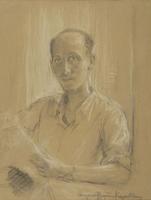
Portrait of Yannis Tsarouchis
Thalia Flora-Karavia
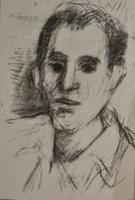
Dery Tibor
Bela Czobel
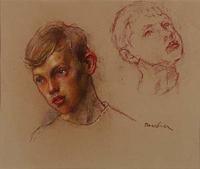
Pastel
Robert Brackman
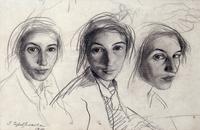
Self-Portrait
Zinaida Serebriakova
Self Portrait
Petre Otskheli
Czobel Bela Lány
Bela Czobel
Ali
Martin Yeoman
Portrait of composer Dmitri Shostakovich (in adolescence)
Boris Kustodiev
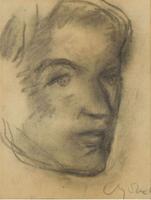
Női Arc
Bela Czobel
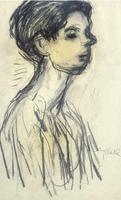
Czóbel Béla Nő Profilból
Bela Czobel
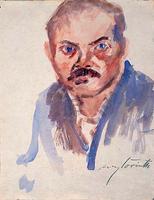
Self-Portrait
Lovis Corinth
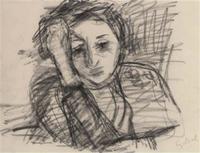
Czobel Bela Women Head
Bela Czobel
Study of khakasy
Vasily Surikov
Peasant Woman, Head
Vincent van Gogh
Berény Róbert , Önarckép 1912
Berény Róbert
Self-Portrait
Pablo Picasso
Head of a Peasant Woman, Bareheaded
Vincent van Gogh
Self Portrait
Josef Albers