
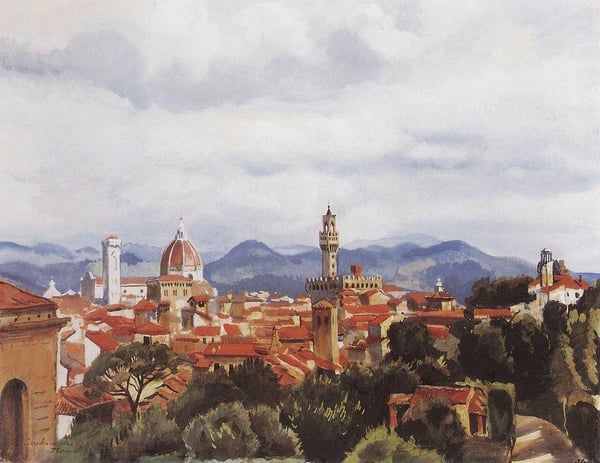
Expert analysis of Zinaida Serebriakova’s Florence
Style: Expressionism · Genre: cityscape
Expert Analysis: Florence by Zinaida Serebriakova
Style & Period Context
While Zinaida Serebriakova is often associated with the Russian Impressionist and Mir iskusstva (World of Art) traditions, her later works—including cityscapes like Florence—absorb elements of Expressionism. This shift marks a significant moment in her career: after emigrating to France in 1924, she engaged with Western modernist currents while retaining her signature lyrical realism. In Florence, the Expressionist approach is evident in the heightened emotional resonance of the urban scene, where architectural forms are not merely recorded but infused with the artist’s subjective response to the city’s storied atmosphere.
Composition & Technique
Serebriakova’s use of bold, often unnaturalistic color—warm ochres, deep terracottas, luminous blues—amplifies the sensory experience of Florence. The brushwork is both fluid and structured, allowing the city’s iconic skyline (domes, towers, rooftops) to emerge from a veiled intensity of light and shadow. This is not a topographical study; it is an emotional translation of the Renaissance city as a living, breathing entity. The perspective is often slightly elevated, as if the viewer is part of the landscape, immersed in the rhythm of its streets and skies.
Significance within Expressionist Cityscapes
What makes Florence remarkable is the fusion of Serebriakova’s distinct feminine sensibility with Expressionism’s drive toward psychological depth. Unlike the more angular, alienating city visions of German Expressionists (e.g., Kirchner’s Berlin street scenes), Serebriakova’s Florence retains a sense of warmth and intimacy. She humanizes the grand architectural scale, suggesting that even a historic city can be a personal, lived experience. This work also challenges the male-dominated narrative of early 20th-century Expressionism, asserting that women artists could equally interpret urban modernity through a modernist lens.
Broader Artistic Legacy
For Serebriakova, Florence is a testament to her ability to evolve—she moved from the aristocratic portraits of her early Russian years to a more universal, emotive landscape idiom. The painting stands as a bridge between Eastern and Western European art, combining the structural clarity of Russian landscape tradition with the chromatic freedom of Expressionism. It remains significant for its demonstration that Expressionist cityscapes could be poetic and inviting, not solely chaotic or alienating.
Visually similar
20 works with related composition and palette
View of Florence
Carlo Ademollo
Florence, The Boboli Gardens
Camille Corot
Florence. Walk.
Vasily Surikov

View of Florence from San Miniato
Thomas Cole
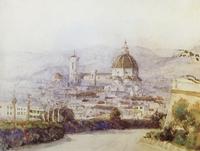
Florence
Vasily Surikov
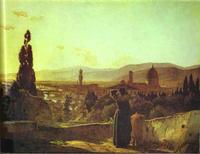
Florence
Nikolai Ge
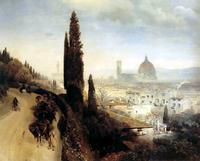
View of Florence
Oswald Achenbach
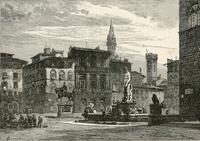
La Fontana Del Nettuno, in Piazza Della Signoria
Gustav Bauernfeind
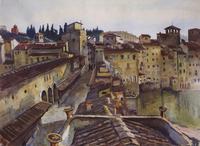
Florence. Ponte Vecchio
Zinaida Serebriakova
Santa Maria De' Bardi
Telemaco Signorini
Evening. Old Florence
Tetyana Yablonska
The Forum Seen from the Farnese Gardens
Camille Corot
A panoramic view of Rome
Giovanni Battista Lusieri
Czene Béla, Randevú 1990
Czene Béla
View of Rome from the window
Hendrik Voogd

Dome of the Santa Maria del Fiore cathedral (Florence)
Filippo Brunelleschi
View of the Roofs of Florence
Max Liebermann
The Piazza della Signoria in Florence
Bernardo Bellotto

On Gianicolo
Gheorghe Tattarescu
My terrace, Florence
Odoardo Borrani