
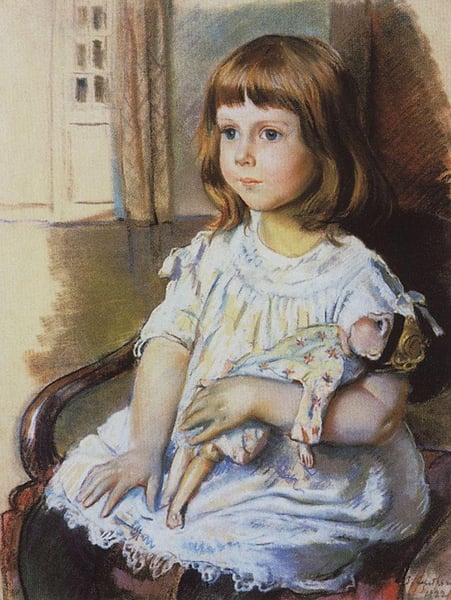
Análisis experto de Girl with a Doll de Zinaida Serebriakova
Estilo: Expressionism · Género: portrait
Expert Analysis: "Girl with a Doll" by Zinaida Serebriakova
As a portrait rendered in an Expressionist style, "Girl with a Doll" occupies a distinctive place within Serebriakova’s oeuvre and within early 20th‑century Russian art. While the artist is best known for her luminous, naturalistic scenes of peasant life and intimate family moments, here she adopts Expressionism’s core impulse: to prioritize emotional truth over literal representation.
Significance within Expressionism:
The painting exemplifies Expressionism’s drive to externalize inner states through deliberate distortion and heightened color. Serebriakova’s handling of the girl’s face and figure likely exaggerates or simplifies features — elongation of the neck, angular shoulders, or unnaturally large eyes — to evoke a sense of vulnerability or psychological distance. The doll, a common motif of childhood, may be rendered with equal emotional weight: perhaps as a companion, a double, or a cipher for lost innocence. The palette (which we can infer from typical Expressionist practice) would be non‑naturalistic — cool blues or acidic greens in the shadows, warm pinks or oranges in the flesh — creating an uneasy tension between the subject’s youth and the viewer’s perception of unease.
Significance within Serebriakova’s Career and Period:
Serebriakova (1884–1967) came of age as Russian modernism was fragmenting into competing movements. By choosing Expressionism for this portrait, she engaged with a pan‑European language of subjectivity, yet she grounded it in the intimate, domestic sphere that was her signature. This artwork stands out because it shows Serebriakova experimenting with a more radical, psychologically charged idiom than her better‑known works. The doll acts as both a real object and a symbolic vessel — a technique that aligns Expressionist portraiture with the era’s interest in the inner life of children, as seen in the works of Egon Schiele or Paula Modersohn‑Becker.
Conclusion:
"Girl with a Doll" is significant as a rare fusion of Serebriakova’s tender subject matter with Expressionism’s formal intensity. It demonstrates how a female artist in early 1900s Russia could adapt an avant‑garde style to probe the complexities of childhood and femininity, leaving behind a portrait that resonates not as a simple likeness, but as an emotional record.
Visualmente similares
20 obras con composición y paleta relacionadas
Girl with a Doll
Kuzma Petrov-Vodkin
Portrait of the artist's daughter
Joan Brull
The doll
Isidoro Grünhut
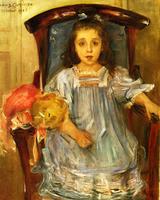
Portrait of Sophie Cassirer
Lovis Corinth
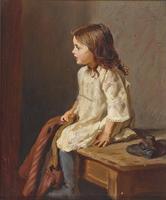
Girl sitting on a table
Felix Schlesinger
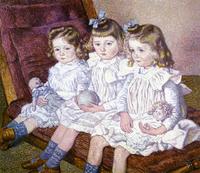
Thomas Braun's Three Daughters
Theo van Rysselberghe
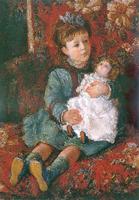
Portrait of Germaine Hoschede with a Doll
Claude Monet
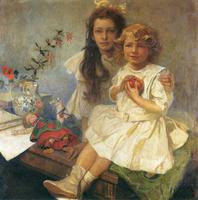
Jaroslava and Jiri, the Artist's Children
Alphonse Mucha
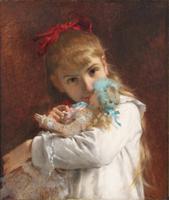
A New Doll(also known as Little Girl)
Pierre-Auguste Cot
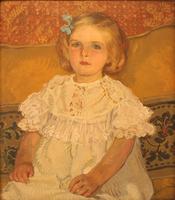
Portrait of a Girl
Józef Mehoffer
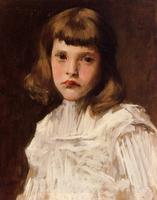
Portrait of Dorothy
William Merritt Chase
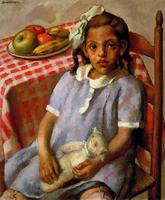
Somewhere In America
Robert Brackman
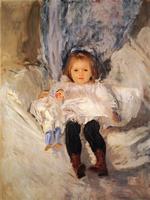
Ruth Sears Bacon
John Singer Sargent
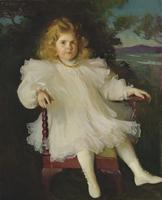
Portrait of Marjorie Coldwell Westinghouse
Frank W. Benson

Little girl
Filadelfo Simi
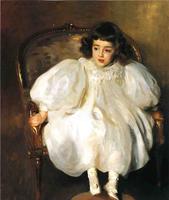
Expectancy
John Singer Sargent
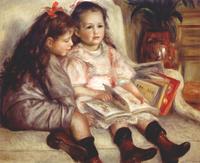
Portraits of Two Children
Pierre-Auguste Renoir
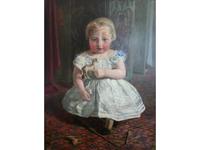
Portrait of a child
Edward R. Taylor
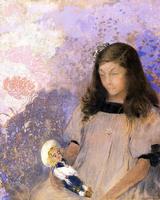
Portrait of Simone Fayet
Odilon Redon
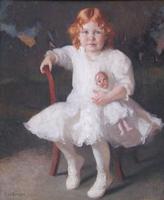
Portrait of Mary Spencer Fuller
Frank W. Benson