Expert analysis of Zinaida Serebriakova’s Portrait of a Jewish philanthropist Igor S. Hurwitz
Style: Expressionism · Genre: portrait
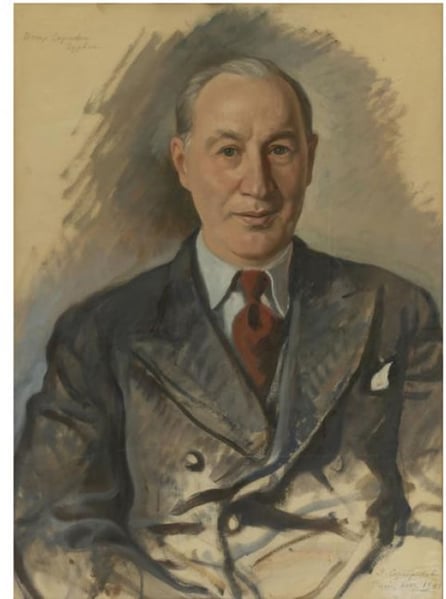
Expert Analysis: "Portrait of a Jewish Philanthropist Igor S. Hurwitz" by Zinaida Serebriakova
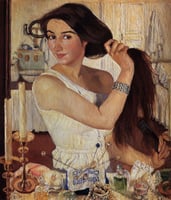
Zinaida Serebriakova, a master of lyrical portraiture and a member of the Russian avant-garde's early circle, is best known for her serene, classical nudes and tender family scenes. However, this portrait marks a significant departure into Expressionism, a style she rarely employed with such explicit emotional force. The work’s significance lies in its seamless fusion of Serebriakova’s refined draftsmanship with the psychological intensity of Expressionist portraiture, creating a deeply humanized depiction of a notable Jewish philanthropist.
Key Significance within Expressionism and Portraiture:
-
Emotional and Psychological Depth: Unlike her earlier, more decorative works, Serebriakova here prioritizes inner truth over outward beauty. The sitter, Igor S. Hurwitz, is not idealized but rendered with an unflinching, even somber, expressiveness typical of Expressionism. The artist likely used exaggerated or distorted facial features, intensified color, and an emotive brushwork to convey Hurwitz’s intellectual gravity, resilience, and the weight of his philanthropic mission. This aligns with Expressionism’s core goal: to express the subjective experience of the artist and the sitter rather than objective reality.
-
Cultural and Historical Subtext: Portraits of Jewish philanthropists in the early 20th century—especially in the émigré context—often navigated themes of identity, displacement, and social responsibility. Serebriakova, who fled revolutionary Russia and settled in Paris, was acutely aware of the plight of exiles. By painting Hurwitz, she documents a figure of cultural and humanitarian significance. The Expressionist style amplifies the sitter’s individuality and perhaps hints at the tension between public benefaction and private melancholy, a hallmark of the period’s psychological portraiture.
-
Stylistic Innovation: Serebriakova’s adoption of Expressionism here challenges the assumption that she was strictly a neo-classicist or realist. This portrait demonstrates her versatility and her engagement with modernist currents sweeping through the Parisian art scene of the 1920s–30s. The bold handling of form and color, combined with her traditional compositional rigor, results in a work that bridges academic portraiture and avant-garde emotionalism, making it a rare and valuable outlier in her oeuvre.
In summary, this portrait is significant not only as a testament to Serebriakova’s range but also as a powerful synthesis of Expressionist emotion and the dignified representation of Jewish philanthropy during a turbulent era. It stands as a compelling psychological study and a historical document of a singular life, rendered with the urgency and intensity that define the best of Expressionist portraiture.
Visually similar
20 works with related composition and palette
Portrait Ing. K
Matej Sternen
Portrait of Julius Freund
Max Slevogt
Portrait of A. Winner
Martiros Sarian
Portrait of S. Shervinsky
Martiros Sarian
Portrait of poet K.P. Cavafy
Thalia Flora-Karavia
A Portrait of Graf Platon Zubov
Zinaida Serebriakova
Portrait of a man
Nicolae Vermont
Portrait of V. F. Sakharov
Pyotr Konchalovsky
Portrait of a doctor
Martiros Sarian
Portrait of A. I. Alikhanov
Martiros Sarian
Portrait of Andreas Vurlumis
George Mavroides
Portrait of gentleman
Zinaida Serebriakova
Portrait of Felicien Qaqaan
Zinaida Serebriakova
Portrait of Dr. Davide D’Osmo
Umberto Veruda
Self-Portrait
Ipolit Strambu
Portrait of the Artist's Father
Archibald Motley
Milutin Milanković
Paja Jovanovic
Portrait of W.A.F. Banner
Isaac Israels
Portrait of Peter Andreievich Pavlenko
Pyotr Konchalovsky
Portrait of Piotr Ge, the Artist's Son
Nikolai Ge