Expert analysis of Zinaida Serebriakova’s Portrait of Sergei Rostislavovich Ernst
Style: Expressionism · Genre: portrait
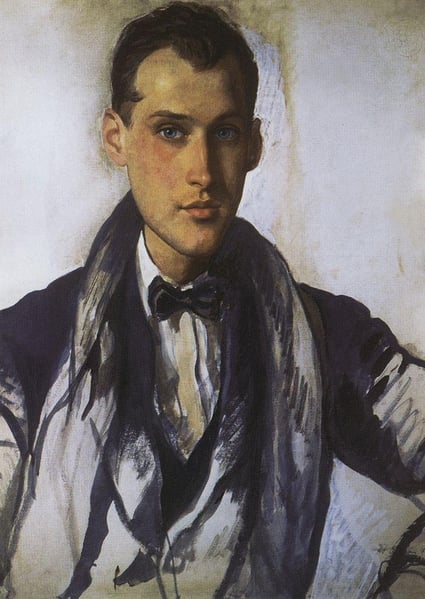
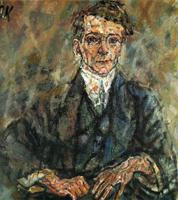
The Portrait of Sergei Rostislavovich Ernst by Zinaida Serebriakova holds a distinctive place within the artist’s oeuvre and within the broader context of early 20th-century Russian Expressionism. While Serebriakova is best known for her lyrical, Neoclassical-tinged portraits and scenes of peasant life, this work demonstrates a bold, psychologically charged departure that aligns with Expressionist principles.
Significance within Expressionism and Period Context:
- Psychological Intensity: The portrait goes beyond mere likeness to probe the inner life of the sitter—an eminent art historian. Through exaggerated features, dynamic brushwork, and a compressed spatial plane, Serebriakova emphasizes Ernst’s intellectual intensity and introspective nature, a hallmark of Expressionist portraiture.
- Color and Emotion: Serebriakova employs a heightened, non-naturalistic palette. Cold blues, greens, and stark whites against deep shadows create a mood of restrained tension, reflecting the turmoil of the interwar period (likely painted during her emigration in Paris). This emotional use of color distinguishes the piece from her earlier, more luminously realistic work.
- Formal Innovation: The composition eschews traditional balanced symmetry in favor of an off-center, almost confrontational gaze. The sitter appears slightly compressed within the frame, a device that intensifies the sense of psychological immediacy and aligns with German and Russian Expressionist portraiture of the 1920s–30s.
Art-Historical Importance:
- Rare Expressionist Turn: For Serebriakova, an artist who often resisted avant-garde extremes, this portrait represents a significant stylistic experimentation. It proves her ability to adapt Expressionist vocabulary—distortion, emotional subjectivity—without losing her rigorous draftsmanship.
- Subject’s Role: Sergei Ernst was a key figure in Russian art history, and his portrait becomes a meta-commentary on the artist-historian relationship. Serebriakova captures not just a man, but the weight of cultural memory and exile, making the work a poignant document of the Russian diaspora.
In sum, this portrait is significant as a synthesis of Serebriakova’s classical training with Expressionist emotional urgency, offering a rare psychological depth that enriches our understanding of both the artist and the period.
Visually similar
20 works with related composition and palette
Portrait of Paul Johann Ludwig von Heyse
Adolph Menzel
Portrait of Ivan Golubovsky
Oleksa Novakivskyi
Portrait of Ambroise Vollard
Paul Cezanne
Seated Peasant
Paul Cezanne
Self-portrait at fifteen
Émile Friant
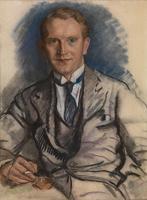
Portrait of a Man
Zinaida Serebriakova
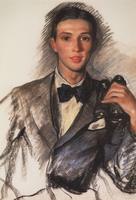
Portrait of the Artist D. Bushena
Zinaida Serebriakova
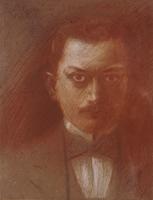
Self-Portrait
Konstantinos Parthenis
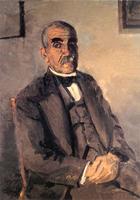
Ahmad Mazloum Bacha
Mahmoud Saiid
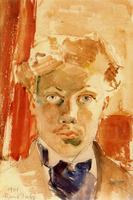
Self-Portrait
Raoul Dufy
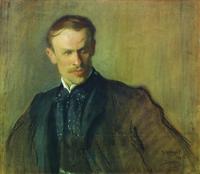
Portrait of L.P. Albrecht
Boris Kustodiev
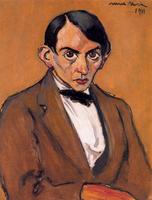
Portrait of a Man
Albert Bloch
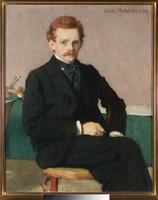
Self-portrait
Józef Mehoffer
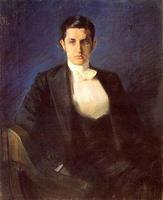
Dmitry Filosof portrait
Leon Bakst
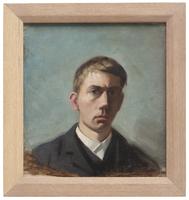
Självporträtt
Eugène Jansson
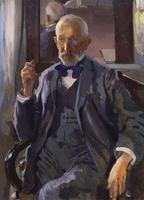
Portrait of A. Somov, the Artist's Father
Konstantin Somov
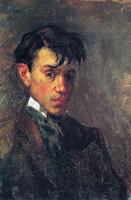
Self-Portrait
Pablo Picasso
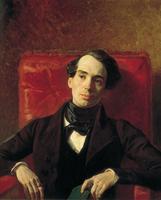
Portrait of the Poet and Translator A. N. Strugovshchikov
Karl Bryullov
Egon Wellesz
Oskar Kokoschka
Girl with tie
Zinaida Serebriakova