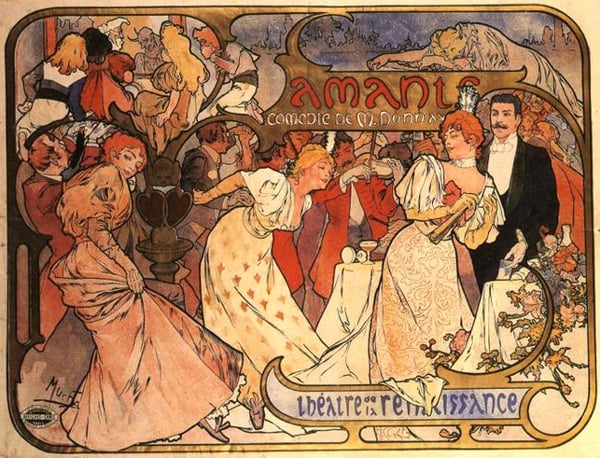
Expert analysis of Alphonse Mucha’s Amants
Style: Art Nouveau (Modern) · Genre: poster
"Amants" by Alphonse Mucha stands as a defining example of Art Nouveau poster art, a genre he elevated to a fine art form. Its significance lies in how it embodies the movement’s core principles: the fusion of beauty and function, the celebration of the natural world through sinuous, organic lines, and the idealization of the female figure as a central motif. Mucha’s posters, including "Amants," broke from the dense, academic styles of the 19th century, introducing a modern visual language of flat, decorative planes, pastel palettes, and halos of mosaic-like ornament. The work’s commercial purpose—advertising a theatrical production or product—never undermines its artistic ambition, demonstrating that modernity could thrive within mass media. In "Amants," the intertwined figures and flowing drapery create a rhythmic, almost musical composition, typical of Mucha’s signature “le style Mucha,” which came to define the Art Nouveau poster’s international appeal. This work is significant not only as a masterful example of the style but also as a catalyst that proved posters could be collected as high art, influencing graphic design and visual culture for decades.
Visually similar
20 works with related composition and palette
Heidsieck
Alphonse Mucha
Illustration
Gerda Wegener
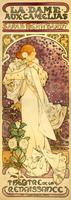
The Lady of the Camellias
Alphonse Mucha
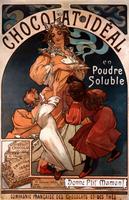
Chocolat Ideal
Alphonse Mucha
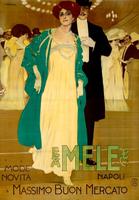
Magazzine Mele
Leopoldo Metlicovitz
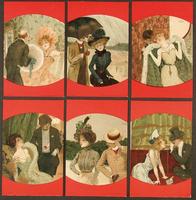
Couples between red borders
Raphael Kirchner
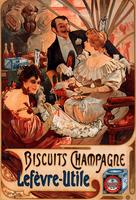
Biscuits Champagne Lefèvre Utile
Alphonse Mucha
The Toilet of Helen
Aubrey Beardsley
Die Prinzessin Und Der Schweinehirt
Heinrich Lefler
Féerie in Tre Atti E 16 Quadri
Leopoldo Metlicovitz
Sauvee
Theophile Steinlen
The ball
Henri de Toulouse-Lautrec
L'Honneur du Patron
Theophile Steinlen
Couples between red borders
Raphael Kirchner
Husdan recognizes his master
Arthur Rackham
Untitled
Constantin Guys
Heart Lady
Raphael Kirchner
Théâtre de l'Opéra, Carnaval 1894
Jules Cheret
The happy prince
Charles Robinson
The New York Daily News
Alphonse Mucha