Analyse experte de Woman and Bird in the Night de Joan Miro
Style : Surrealism · Genre : abstract
Expert Analysis: "Woman and Bird in the Night" by Joan Miró
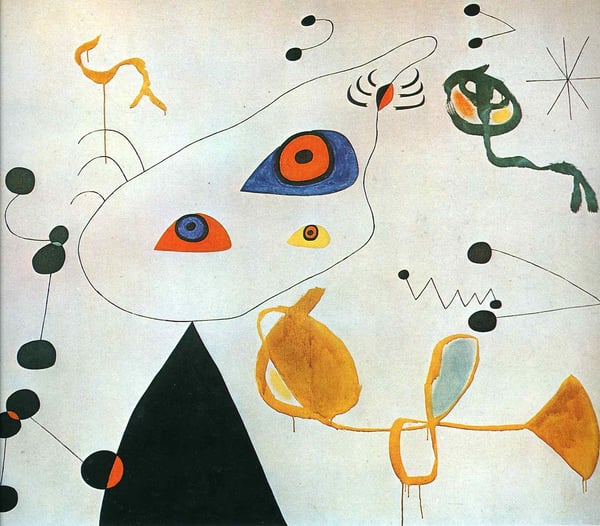
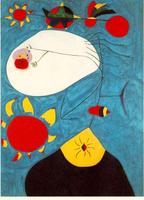
Joan Miró’s "Woman and Bird in the Night" stands as a quintessential example of Surrealism’s embrace of the subconscious, while pushing the boundaries of abstraction into a deeply personal symbolic language. Although the work is categorized as abstract, it remains tethered to Surrealism’s core mission: to liberate imagination from rational control. Miró achieves this through a radical simplification of forms, reducing the titular figures—woman and bird—into floating, biomorphic shapes that hover in a nocturnal void.
Significance within Surrealism and Abstract Art
- Automatic Drawing and Dream Logic – Miró famously employed automatic techniques to bypass conscious thought, allowing lines and colors to emerge instinctively. In this piece, the “woman” and “bird” are not literal depictions but psychic residues: a curved silhouette, a dot for an eye, a slender beak-like form. The “night” setting amplifies the dreamlike atmosphere, where gravity and proportion dissolve.
- Abstraction as Surrealist Tool – Unlike many Surrealists who retained recognizable imagery (e.g., Dali’s melting clocks), Miró pushed toward near-total abstraction, yet his symbols remain emotionally legible. Here, the tense black lines and floating color patches evoke a primal encounter—a dialogue between the earthly (woman) and the ethereal (bird), set against the infinite darkness of night.
- Microcosm of Miró’s Visual Language – The work exemplifies Miró’s mature style: a reduced palette (often primary colors with black and white), playful yet precise calligraphy, and a childlike sense of wonder that belies profound psychological depth. The bird, a recurring motif in his oeuvre, symbolizes freedom and transcendence; the woman, fertility or the muse. Their interaction in the night suggests a ritualistic union of opposites.
Period Context
Created during Miró’s peak Surrealist phase (late 1920s–1940s), “Woman and Bird in the Night” aligns with his desire to “assassinate painting” by rejecting traditional perspective, shading, and narrative. Instead, he offers a flat, hieroglyphic space where the viewer’s unconscious completes the story. This approach influenced later abstract expressionists (e.g., Pollock, Motherwell) who admired Miró’s ability to convey emotional intensity through pure gesture and form.
Why It Matters
This work is significant because it demonstrates how Surrealism could abstract complex human themes (desire, mystery, the subconscious) into universal symbols without losing emotional resonance. Miró’s “woman and bird” are not just shapes—they are archetypes that speak to the dreamer in all of us, making the night both intimate and infinite. In this, “Woman and Bird in the Night” remains a landmark of Surrealist abstraction, where the irrational becomes not merely strange, but profoundly meaningful.
Museum / Gallery
Genre
Style
Visuellement similaire
20 œuvres à la composition et à la palette proches
Women and Birds at Sunrise
Joan Miro
Woman and Bird in the Night
Joan Miro
The Port
Joan Miro
Constellation Awakening at Dawn
Joan Miro
Ciphers and Constellations, in Love with a Woman
Joan Miro
Untitled
Ilya Bolotowsky
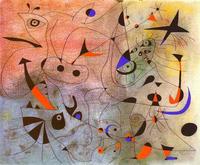
Constellation: The Morning Star
Joan Miro
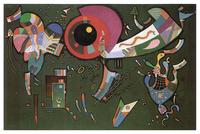
Around the circle
Wassily Kandinsky
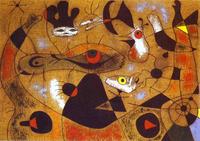
A Dew Drop Falling from a Bird's Wing Wakes Rosalie, who Has Been Asleep in the Shadow of a Spider's Web
Joan Miro
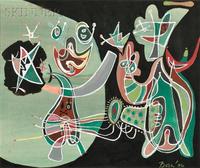
Transfigured Night
Peter Busa
The Escape Ladder
Joan Miro
Woman with Blond Armpit Combing Her Hair by the Light of the Stars
Joan Miro
The Escape Ladder
Joan Miro
Blue segment
Wassily Kandinsky
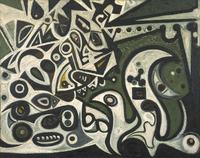
River Metamorphosis
Richard Pousette-Dart
study #011
Toshihiko Okuya
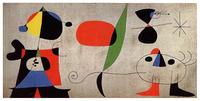
Joaquim Gomis (Mural)
Joan Miro
Rhythmic Composition
Ernst Wilhelm Nay
Portrait IV
Joan Miro
Untitled
Gaston Chaissac