Dante Gabriel Rossetti sanatçısının Jane Morris eseri hakkında uzman analizi
Tarz: Romanticism · Tür: sketch and study
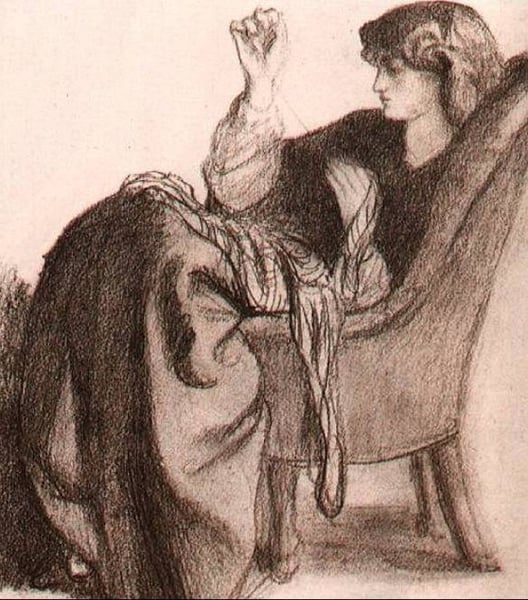
This sketch of Jane Morris by Dante Gabriel Rossetti is a telling artifact of the artist’s mature Romantic sensibility, and its significance lies in how it distills the core ideals of the Pre-Raphaelite branch of Romanticism into an intimate, unguarded format. As a sketch and study, it does not aim for the polished finish of a completed oil painting; instead, it grants us immediate access to Rossetti’s creative process and his obsessive visual devotion to his muse.
Significance within Romanticism and the Pre-Raphaelite Circle:
- The Cult of the Muse: Jane Morris was Rossetti’s obsessive subject and later his companion. In this study, her distinctive features—the heavy-lidded eyes, full lips, strong jaw, and cascading hair—are recorded with a sense of reverent urgency. The sketch format emphasizes her as an idea as much as a person; she is the embodiment of the Romantic ideal of melancholic, introspective beauty, removed from the taint of Victorian modernity.
- Spontaneity vs. Idealism: While Romanticism prized emotional authenticity, Pre-Raphaelite work was often highly detailed. This sketch bridges that gap: the loose, rapid strokes of the pencil or chalk capture a fleeting moment of presence, yet the composition is carefully arranged to emphasize her elongated neck and pensive demeanor. It shows Rossetti working through his idealization in real time, making the study a record of desire and artistic labor.
- Process as Revelation: By classifying the piece as a sketch and study, we see Rossetti’s preparatory methods. Such studies were often used to work out poses for larger paintings like The Daydream or Proserpine. This one is significant because it reveals how Rossetti constructed his iconic female type—systematically refining the jawline, the curve of the shoulder, the fall of the hair. The sketch thus functions as a Rosetta Stone for understanding the finished, iconic images of Jane that define the latter half of his career.
- Aestheticism in Embryo: Though Rossetti is aligned with Romanticism, his later work leaned toward Aestheticism—art for art’s sake. This study, with its focus on pure linear grace and the arrangement of facial features rather than narrative or moral lesson, anticipates that shift. The significance here is that the sketch is simultaneously a Romantic expression of personal emotion and a formal exercise in beauty.
In essence, the artwork’s importance stems not from what it depicts (a woman sitting), but from how it depicts her: as a haunted, sculptural presence rendered with a hand that is both tender and analytical. It is a key document of the Romantic obsession with the individual psyche, the cult of the beloved, and the belief that a preliminary study could hold as much raw power as a finished masterpiece.
Görsel olarak benzer
İlişkili kompozisyon ve renk paletine sahip 20 eser
Seated Saskia with a letter in her left hand
Rembrandt
Silence
Dante Gabriel Rossetti
A Study of a Woman Asleep
Rembrandt
Miss Fabia, the Younger, astonished at the Patrician's Double-knock
John Leech
Anna Karenina meets her son
Mikhail Vrubel
Seated Italian woman in her costume while spinning
Ernst Meyer
Madonna and Child
Albrecht Durer
Bent Figure of a Woman
Vincent van Gogh
Seated Woman
Adriaen van de Velde
The Girl Squatted Down
Peter Paul Rubens
Interior with Peasant Woman Sewing
Vincent van Gogh
Woman Carding Wool
Jean-Francois Millet
Bent Figure of a Woman Sien
Vincent van Gogh
Jewish Woman of Algiers
Eugene Delacroix
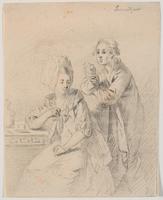
Portrait of Frederik Carl Trant and His Wife Cornelia Née Schumacher 1770
Christian August Lorentzen
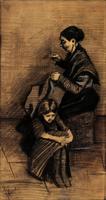
Woman Sewing, with a Girl
Vincent van Gogh
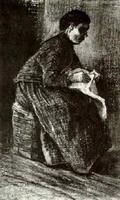
Woman Sitting on a Basket, Sewing
Vincent van Gogh
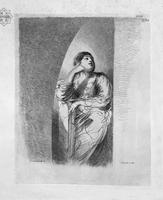
Half figure of seated woman, her face resting on his right hand, by Guercino
Giovanni Battista Piranesi
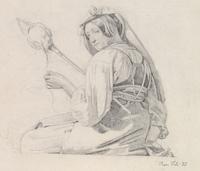
A seated woman in roman dress, spinning (July 1833)
Theodor Leopold Weller
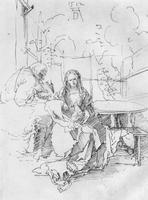
The Holy Family in the arbor
Albrecht Durer